
You refresh your freelance platform for the third time today. Another bid rejected — not because your proposal was weak or your portfolio unconvincing, but because someone in a lower-cost region undercut your rate by 60% and the platform provided no way to prove your code quality justifies the difference.
This isn't a skill problem.
The frustration compounds when you realize 1.57 billion people freelance worldwide, making up 47% of the global workforce and turning every project listing into a bidding war. Yet senior coders can close contracts at $50+ per hour while you’re stuck explaining why you deserve more than $15.
The difference? They position themselves differently.
This guide shows how to access premium-rate opportunities through strategic specialization, platform selection that supports quality differentiation, and alternative income through code evaluation work where measurement infrastructure actually justifies expert-level compensation.
1. Understand why most freelance platforms compete on price (not quality)
Generic freelance platforms can only measure deliverable completion: feature works or doesn't, deadline met or missed, client satisfied or not. This binary measurement forces developers into price competition because platforms lack the infrastructure to differentiate code quality beyond client acceptance.
The binary measurement trap
Consider what this means in practice.
When a client posts "build a responsive dashboard with React," the platform sees twenty qualified developers bidding between $15 and $50 per hour. Without technology to evaluate whose code will be maintainable, secure, and performant months later, clients default to price as the primary decision factor.
The $15/hour developer from a lower-cost region can get the project because the platform provides no way to prove the $50/hour developer delivers superior long-term value.
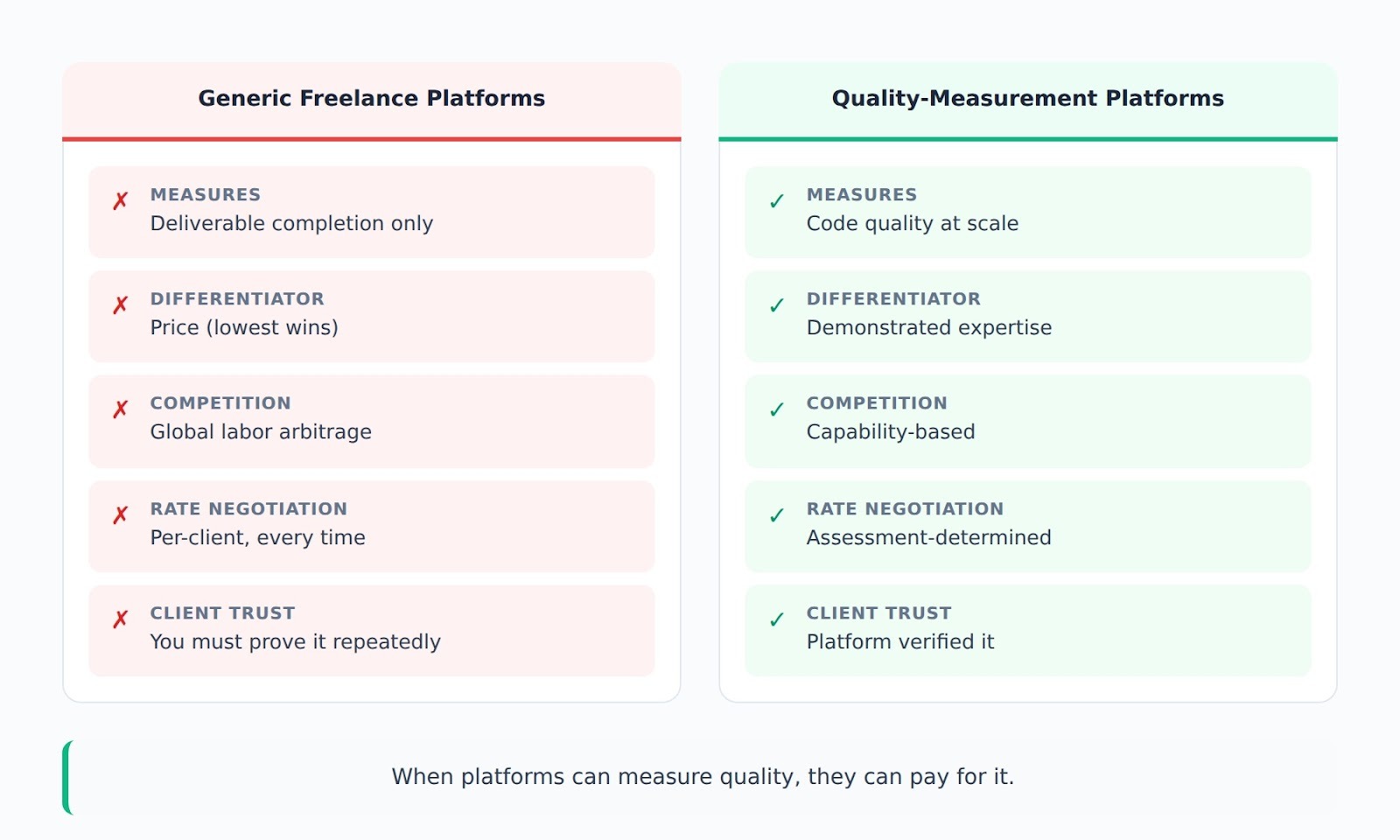
The economic reality: platforms operating this way push experienced developers toward either accepting commodity rates or spending enormous effort convincing individual clients that code quality matters. Neither option is sustainable when you're competing against global labor arbitrage.
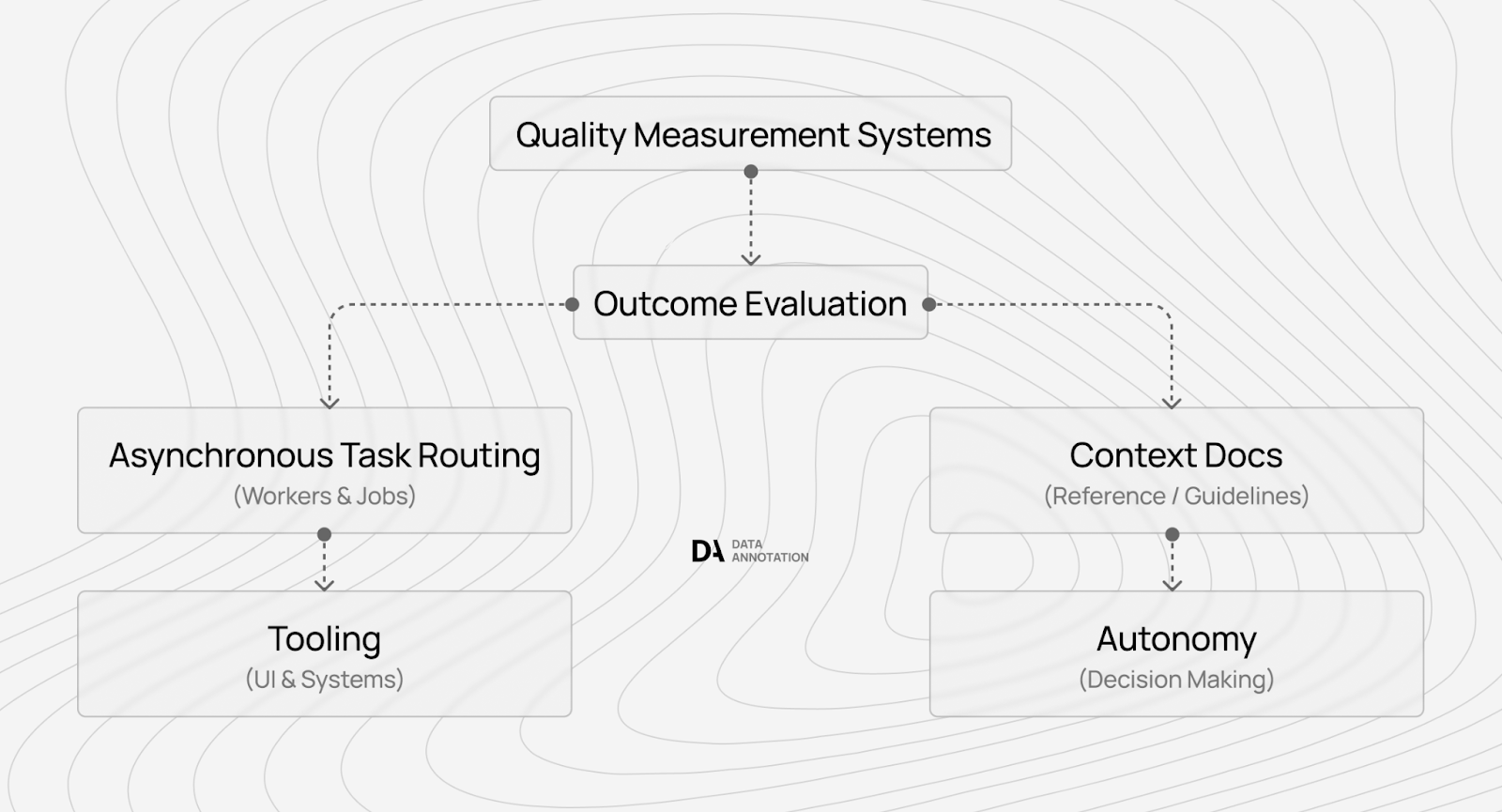
This measurement problem explains why platforms that actually measure quality operate differently. When technology can verify that your code evaluation catches subtle errors others miss, compensation follows demonstrated capability rather than client negotiation.
Where quality measurement works
Premium freelance opportunities exist where quality measurement infrastructure actually works. These might be specialized networks that rigorously vet developers, long-term client relationships where you've proven value through results, or platforms that measure code evaluation expertise rather than just feature delivery.
The common thread: some mechanism exists to verify, and price quality beyond "client accepted the work."
For developers seeking alternatives to the race-to-the-bottom dynamics, understanding this measurement problem explains why traditional freelance platforms struggle to support premium rates consistently. It's not that clients don't value quality — it's that platforms can't measure it, so they default to charging by the hour for commodities.
2. Specialize in domains where quality measurement exists
Generic full-stack developers compete with thousands of others for the same low-margin projects. The current market rewards depth over breadth, particularly in domains where clients can actually measure the business impact of superior code quality.
Example of high-value domains with measurable impact
AI/ML engineering, cybersecurity, cloud reliability engineering, and blockchain development command premium rates because failures in these domains have measurable consequences.
When a machine learning model produces biased outputs or a security vulnerability exposes customer data, the business impact is quantifiable. This creates environments where clients can distinguish quality levels and are willing to pay accordingly.
For instance, Machine Learning Engineers earn $120K–$180K+ annually, while Site Reliability Engineers can earn $110K–$165K. These rates reflect measurable business outcomes: improved model accuracy drives revenue, reduced downtime saves operational costs, and successful security audits prevent compliance violations.
Generic feature development can't create these clear value propositions.
The same principle applies to AI training work: coding projects starting at $40/hour exist because evaluating whether AI-generated code creates technical debt requires the judgment that generic annotators can't provide and automated systems can't verify.
Building credible specialization
The path to specialization starts with choosing one domain that aligns with your interests and has demonstrated market demand. Commit to building genuine expertise through recognized credentials like AWS Solutions Architect, TensorFlow Developer, or Certified Ethical Hacker. These certifications signal competence to clients.
Build one focused project that demonstrates your specialty with measurable outcomes.
For example, rather than positioning yourself as "full-stack developer available for hire," you can frame it as "the ML engineer who reduced prediction latency by 60%" or "the security specialist who prevented three major vulnerabilities in production systems."
This specificity justifies premium rates because clients see direct business value rather than generic technical capability.
How specialization changes your competitive position
Explicit specialization also changes your competitive landscape. Instead of competing with every developer globally who knows JavaScript, you compete with the subset who understand, for example, real-time data streaming architectures for financial trading systems.
This reduced competition, combined with measurable business impact, creates pricing power that generic development work lacks.
3. Target platforms with developer-quality infrastructure
Platform choice directly determines your earning potential and how much time you spend justifying your rates. Generic job boards attract clients seeking cheap labor because these platforms offer no differentiation beyond resume credentials.
Premium developer networks connect you with high-budget projects because their vetting creates environments where clients expect to pay for expertise.
Selective networks vs. generic job boards
Toptal accepts fewer than 3% of applicants to its global talent network, creating a marketplace where clients understand they're paying premium rates for vetted expertise.

This selectivity shifts the conversation from "why should I pay your rate?" to "which vetted developer best fits this project?"
Gun.io and Arc.dev also maintain strict acceptance criteria that signal quality to clients before any individual proposal.
The practical difference: on generic platforms, you spend proposal time explaining why your code quality justifies higher rates. On selective platforms, the vetting process already established this, allowing proposals to focus on approach and fit rather than justifying base competence.
Strategic platform selection
Apply to two or three specialized platforms rather than spreading thin across generic job boards. Each platform has specific audiences and expectations — research what clients typically hire for and optimize your profile accordingly.
Demonstrate expertise in your chosen niche by highlighting business outcomes from past projects with quantifiable metrics.
Here’s a template you can leverage:
- "Reduced API response time by 40%,"
- "Prevented security breach, saving estimated $500K in damages,"
- "Improved model accuracy from 82% to 94%."
Quality platforms convert at higher rates because the clients already expect premium pricing, and the vetting infrastructure removed developers who compete primarily on price. This doesn't eliminate competition, but it changes the terms from "who's cheapest?" to "who delivers best outcomes?"
For developers frustrated by constant rate negotiations, comparing DataAnnotation to alternatives reveals a different model entirely: platforms that measure code evaluation quality directly, paying $40+/hour without the proposal cycles or client bidding wars that consume freelance time.
4. Build portfolio projects that demonstrate business impact
Your portfolio is your primary credibility signal, but most freelance developers present generic CRUD applications or tutorial-derived projects that clients can skim past without engagement.
A focused, outcome-driven portfolio signals specialized expertise and directly affects both how often you receive offers and what rates clients accept without negotiation.
Creating your flagship project
Build one flagship project in your chosen niche that demonstrates real-world problem-solving rather than academic exercises.
For example, a GPT-powered tool that reduces customer support volume by 40%, or an AWS-backed serverless API handling 10,000 requests per second at $50 monthly infrastructure cost. The specific technical achievement matters less than showing you understand how code creates business value.
Portfolio architecture that signals quality
Then, structure your portfolio projects for quick evaluation by busy decision-makers:
- Live demo link allowing hands-on interaction
- Concise README focusing on business outcomes rather than implementation details
- Three to five screenshots showing key functionality and user experience
- One-click deploy scripts demonstrating you understand production deployment considerations
These structural elements allow technical decision-makers to evaluate your work faster than the average.
Framing projects for business impact
Even brief READMEs become compelling when they frame business value rather than listing technologies.
Compare these approaches:
Generic: "Built with Python, TensorFlow, Docker, AWS Lambda, PostgreSQL. Implements microservices architecture with RESTful APIs."
Business-focused: "AI-Powered Inventory Optimization: Reduces overstock costs by 30% through demand prediction. Built with Python and TensorFlow, deployed on AWS Lambda for sub-$100 monthly costs at 100K+ monthly predictions."
The second approach tells clients immediately whether your project solves problems they face and demonstrates you think about cost-effectiveness and business outcomes rather than just technical sophistication.
Host projects on GitHub paired with a minimalist personal site, and add short case studies highlighting concrete outcomes where possible. When every piece ties back to measurable results rather than technical complexity for its own sake, you stop justifying hourly rates and let your work communicate value directly.
This outcome-focused positioning mirrors what premium data annotation jobs actually test: not credentials or portfolio polish, but demonstrated judgment on complex cases. Your debugging instincts and language-specific knowledge — the expertise that makes portfolio projects compelling — translate directly to AI code evaluation.
5. Benchmark rates against value creation (not just market averages)
Lowball bids signal to experienced clients that you don't understand your value. Premium pricing requires market data to ground your rates and positioning that emphasizes outcomes rather than hours worked.
Grounding your rates in market reality
Start with research across multiple sources:
- Filter senior-level projects on specialized boards like Contra
- Scan recent postings on vetted networks to see what clients actually pay
- Review rate per hour or salary data from Glassdoor, ZipRecruiter, or Levels.fyi to understand ceiling rates for your specialty
This data prevents both underpricing (leaving money on the table) and overpricing (pricing yourself out of realistic opportunities).
Shifting from time to impact
The more critical shift: moving conversations from time to impact through value-based positioning. Rather than "I charge $X per hour for development work," frame proposals around business outcomes with clear ROI calculations.
For instance: "This API optimization will reduce your monthly infrastructure costs by $4,000. Your one-time investment is $8,500, breaking even in just over two months." When clients see savings or revenue gains first, price resistance diminishes because you're comparing investment to return rather than comparing hourly rates to cheaper alternatives.
Calculating ROI for your services
Before sending proposals, benchmark a few comparable projects in your niche and estimate the business value your solution creates.
Here are some helpful tips:
- If you're optimizing a checkout flow, research typical conversion-rate improvements and calculate the revenue impact.
- If you're implementing caching, estimate infrastructure cost reductions.
- If you're refactoring code for maintainability, estimate future improvements in development velocity.
These calculations transform your rate from "expensive compared to alternatives" to "reasonable given outcomes."
Positioning value over hours
The positioning principle: clients who can't evaluate code quality default to price comparison. Clients who understand business impact assess ROI. Your goal is to attract clients in the second category or to educate prospects to think this way. Premium rates follow naturally when the conversation centers on value creation rather than hourly costs.
6. Use strategic proposals that address client problems directly
Generic proposals get ignored in crowded client inboxes because they demonstrate no understanding of the specific problem. Personalized outreach beats copy-paste templates because it shows you've invested time understanding what the client actually needs rather than mass-applying to every opportunity.
The 3-step proposal framework
Effective proposals follow a three-step framework:
- Pain: Identify the specific problem you found while researching their site, product roadmap, or recent developments
- Plan: Detail your exact approach, including realistic timelines and technologies you already know
- Proof: Close with a measurable result from a similar past project demonstrating your capability to execute
This framework keeps proposals focused on client outcomes rather than your capabilities, making it immediately clear why they should hire you specifically.
Research-driven personalization
Research makes personalization possible.
Before writing proposals, spend some minutes reviewing the client's website, LinkedIn updates, recent funding announcements, or technical blog posts.
Look for indications of problems your expertise solves: blog posts about scaling challenges if you specialize in performance optimization, security audit requirements in their job descriptions if you focus on security, or mentions of ML initiatives if you work in AI/ML.
Consider adding a 60-second Loom video walkthrough at the top of your proposal, highlighting one clear problem with their current product and explaining your solution approach. Video helps hesitant decision-makers trust you more quickly by demonstrating that you're a real person who invested time in understanding their needs, rather than an automated application.
Proposal tracking and optimization
Track every pitch in a simple spreadsheet with date sent, contact name, follow-up reminder, and outcome. This data sharpens your approach over time — you'll notice which industries respond better, which proposal formats convert more effectively, and which types of projects align best with your expertise.
Ten focused proposals per week that demonstrate a genuine understanding of client needs beat fifty random bids that could apply to anyone.
Quality beats volume when targeting premium clients with budgets and who understand that code quality matters. These clients receive dozens of low-effort proposals and immediately filter out anything generic. Your personalized approach stands out not through flashy design but through demonstrating you understand their specific problem and have relevant expertise to solve it.
For developers exhausted by proposal writing, AI training at DataAnnotation offers an alternative model: projects appear on a dashboard based on your qualified expertise level. No pitching, no proposals, no convincing individual clients that your rate reflects genuine value. Pass the assessment, select projects, start earning.
7. Structure retainers and productized services for income stability
Cash flow that swings from five-figure months to drought periods means you have a billing model problem, not a skill problem. Hourly or per-project work requires constant client hunting, as income stops once active work is complete.
Retainers and productized services generate recurring revenue, stabilize income, and reduce the time spent on sales activities.
Building recurring revenue through retainers
A retainer gives clients ongoing access to your expertise while providing a predictable monthly income. Structure retainer agreements with clearly defined scope, change-order clauses protecting against endless tweaks, and prepaid invoices through PayPal, Stripe, or similar services.
Three clients at $3,000 monthly retainers create a $9,000 baseline covering most expenses, allowing you to be more selective about additional project work rather than accepting anything to maintain cash flow. The psychology shift matters — when you're not desperate for any income, you negotiate better rates and can say no to problematic clients.
Productized services: fixed outcomes at fixed prices
Productized services deliver fixed outcomes at fixed prices, for example:
- "5-Day Security Audit: $5K,"
- "API Performance Optimization Package: $7.5K,"
- "Monthly Code Review Subscription: $2K/month."
These packages transform your expertise into clear, bite-sized purchases that busy CTOs can approve without lengthy proposal cycles. The fixed pricing also makes your time more efficient — you've done similar work before and can complete it faster than with custom projects that require constant clarification.
Converting projects into retainer relationships
The fastest path to your first retainer often comes from projects you just delivered. When hitting final milestones, propose an "optimization and maintenance" package that keeps their application healthy while providing you with a steady income.
Most clients appreciate ongoing support relationships because it's easier than finding new developers when issues arise.
For developers combining traditional freelance contracts with code evaluation work, retainers from ongoing clients, plus flexible AI training income, creates robust income stability. Retainers cover baseline expenses, freelance projects provide growth capital, and code evaluation work fills gaps between contracts without requiring client management overhead.
8. Explore AI training for experts who want to contribute to AGI
Client management overhead, potential conflicts with existing contracts, and scope creep consuming time you're reserving for client search — freelance platforms can slowly drain you out.
AI code evaluation: an alternative to traditional freelancing
If you have exceptional analytical and coding expertise, code evaluation work for AI training offers distinct advantages. Every frontier model depends on human intelligence that algorithms cannot replicate. As models become more capable, this dependence intensifies rather than diminishes.
At DataAnnotation, we operate one of the world's largest AI training marketplaces — over 100,000 experts contributing to frontier AI systems that serve millions. No required meetings. No micromanagement. People work when their brains function optimally, disconnect when they need to, and choose projects that match their expertise.
If you have genuine expertise (coding ability, STEM knowledge, professional credentials, or exceptional critical thinking), you can help build the most important technology of our time at DataAnnotation.
For coding projects (starting at $40/hour), it involves AI-generated code evaluation across Python, JavaScript, HTML, C++, C#, SQL, and other languages.
Getting started with AI training work
At DataAnnotation, entry starts with a Coding Starter Assessment that typically takes about 1 - 2 hours to complete. This isn't a resume screen or a credential check — it's a performance-based evaluation that assesses whether you can do the work.
Once qualified, you select projects from a dashboard showing available work that matches your expertise level. Project descriptions outline requirements, expected time commitment, and specific deliverables.
You can choose your work hours. You can work daily, weekly, or whenever projects fit your schedule. There are no minimum hour requirements, no mandatory login schedules, and no penalties for taking time away when other priorities demand attention.
The work here at DataAnnotation fits your life rather than controlling it.
Is the work hard? Yes. Does it require deep thinking? Absolutely.
Explore freelance coding projects at DataAnnotation
Most platforms offer AI training as gig work, where you earn side income by clicking through microtasks. At DataAnnotation, we‘re at the forefront of AGI development, where your judgment determines whether billion-dollar training runs advance capabilities or optimize for the wrong objectives.
The difference matters. When you evaluate AI-generated code, your preference judgments influence how models balance helpfulness against truthfulness, how they handle ambiguous requests, and whether they develop reasoning capabilities that generalize or just memorize patterns.
This work shapes systems that millions of people will interact with.
If you want in, getting started is straightforward:
- Visit the DataAnnotation application page and click “Apply”
- Fill out the brief form with your background and availability
- Complete the Starter Assessment
- Check your inbox for the approval decision (which should arrive within a few days)
- Log in to your dashboard, choose your first project, and start earning
No signup fees. We stay selective to maintain quality standards. Just remember: you can only take the Starter Assessment once, so prepare thoroughly before starting.
Apply to DataAnnotation if you understand why quality beats volume in advancing frontier AI — and you have the expertise to contribute.
.jpeg)