
If you have ever interviewed for FAANG positions, you might have sunk months into LeetCode drills only to hear "not a culture fit" after acing the technical rounds; you are not alone.
The stats are brutal: Google's acceptance rate is estimated between 0.2% to 0.5%, with roughly 20,000 hires from over 3 million annual applicants, while fewer than 5% of candidates who reach Meta's onsite walk away with an offer.
Those numbers hide a sharper reality for senior engineers: each company tests different skills entirely. Meta demands product-sense system design, Amazon requires 16-principle storytelling, Google expects algorithmic perfection, while Netflix probes autonomous judgment.
Most senior engineers prepare for "FAANG" generically, then fail because they optimized for the wrong bar. Google's algorithmic depth doesn't prepare you for Amazon's behavioral weight. Meta's product thinking doesn't translate to Apple's performance obsession.
This guide breaks down what makes each company uniquely difficult, where experienced engineers stumble most often, and how to calibrate your preparation to the specific bar in front of you rather than aiming for conflicting expectations simultaneously.
FAANG interview difficulty at a glance
Each major tech company, consisting of Facebook (Meta), Amazon, Apple, Netflix, and Google (now Alphabet), tests different strengths with varying intensity.
Here's how they stack up across critical evaluation dimensions:
Success requires calibrating preparation to each company's specific bar, not preparing generically for "FAANG."
1. How hard is Meta's interview process for engineers?
Fewer than 5% of candidates reaching Meta's onsite interviews receive offers, making this one of Big Tech's toughest passes. The brutal rejection rate stems from Meta's unusual combination: deep system design requirements plus an exceptionally high bar for product thinking.
During system design rounds, you'll sketch a real-time billion-user Facebook News Feed, scale Instagram Stories across every timezone, or keep WhatsApp messaging under 100ms median latency.
Interviewers press hard on trade-offs: sharding keys, feed fan-out strategies, push versus pull models, cost controls. They want evidence that you can translate architecture choices into a better user experience, not just prettier diagrams.
Follow-up questions often pivot into product sense, for instance, why a ranking change impacts engagement or how a privacy toggle reshapes data flows, so pure technical depth without business context rarely clears the bar.’
One engineer who interviewed at both Google and Meta described the pace difference on Reddit:
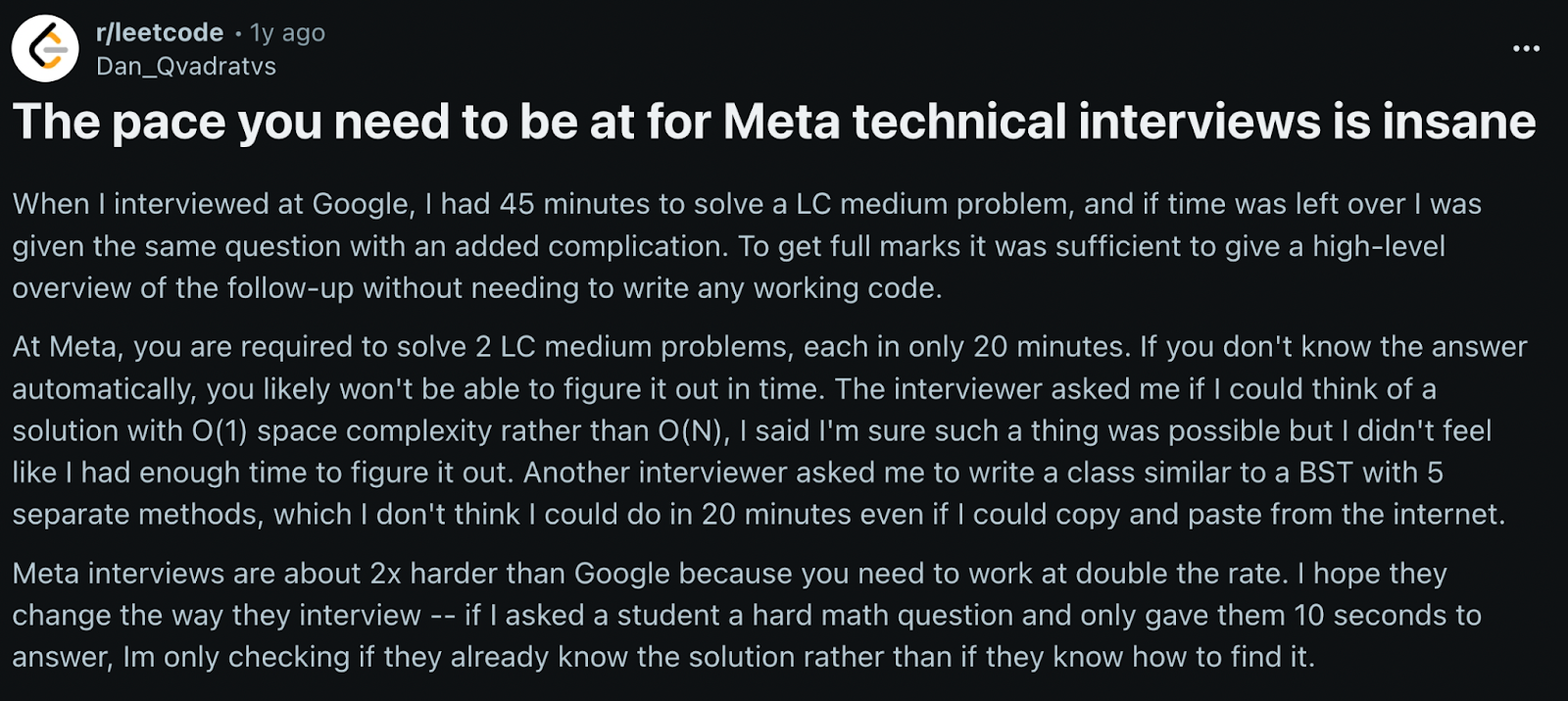
The structural implication: Meta's format rewards candidates who have already internalized specific solutions. If you don't recognize the pattern immediately, the clock runs out before you can derive it.
Senior engineers stumble in three predictable areas:
- Treating product sense as secondary: They nail the technical design but fumble when asked, "Why would users want this feature?"
- Underestimating Meta's scale expectations: Designing for millions works at most companies; Meta expects you to reason about billions of users across conflicting network conditions.
- Giving vague trade-off answers: Hand-wavy responses about "balancing speed and reliability" fail when interviewers want specific choices about eventual consistency versus strong consistency.
A typical senior loop includes two coding rounds (LeetCode medium/hard), two system design rounds (one product-focused, one infrastructure-focused), and one behavioral interview to test "Move Fast" culture fit. Staff+ levels add an architecture deep dive—budget six to eight weeks from application to decision.
Your preparation strategy: study Meta's flagship products deeply, practice designing social features at a planetary scale using resources like the System Design Primer, and craft behavioral narratives that show you can ship quickly without sacrificing resilience.
2. Why is Amazon's interview process so difficult?
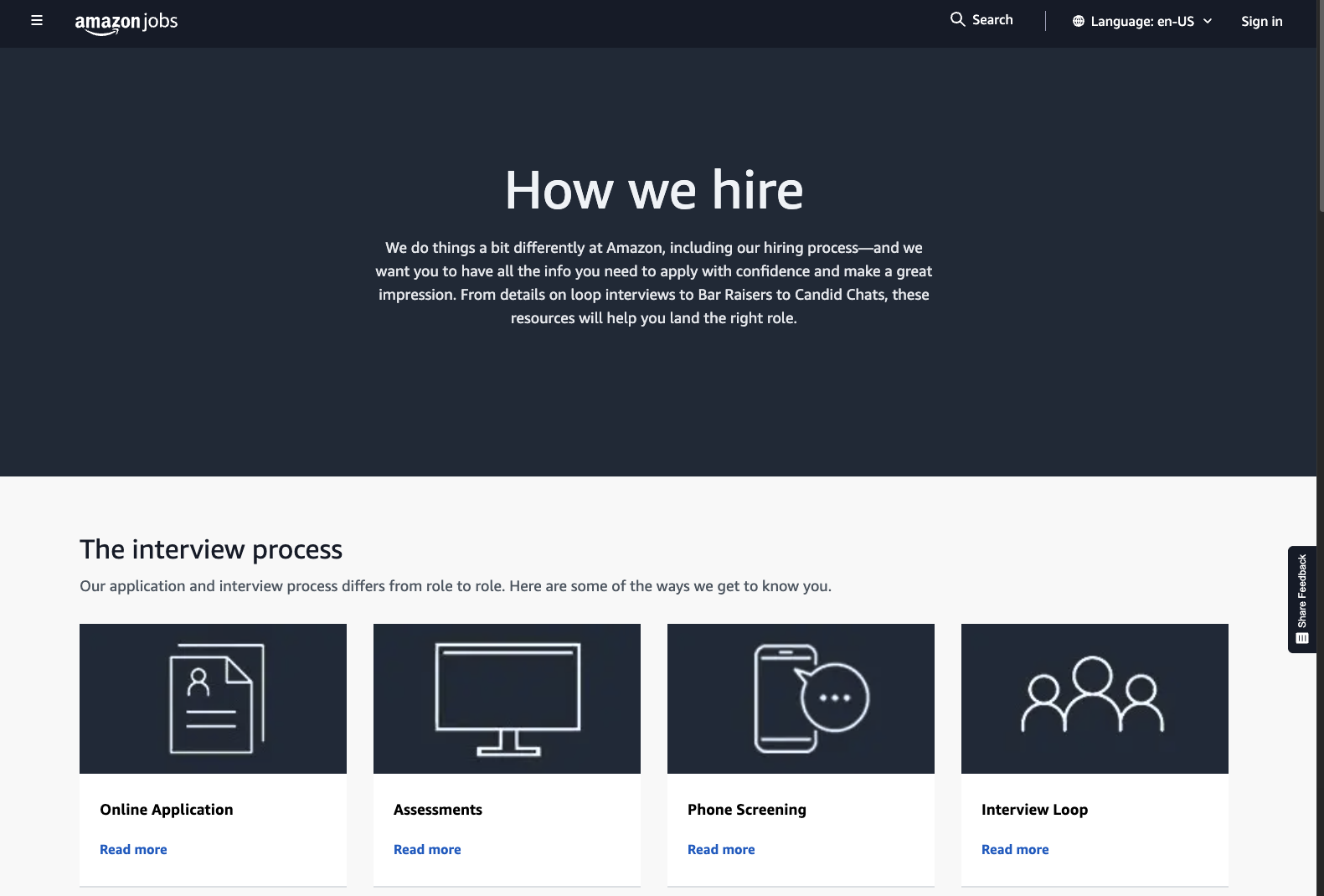
Amazon makes its process uniquely strong: an obsession with 16 Leadership Principles. Every interviewer (technical or behavioral) grades how well your answers align with principles like "Dive Deep," "Ownership," and "Disagree and Commit." Your behavioral performance weighs as much as perfect code.
During onsite interviews, a designated Bar Raiser (an independent engineer who can veto any hire) will probe those principles while testing your ability to think at AWS scale. Expect direct follow-ups like "How would you roll back a regional DynamoDB outage without violating Customer Obsession?"
They want your architectural skills and your ability to balance speed, cost, and reliability in massive distributed systems.
Experienced engineers crash on three failure modes:
- Dismissing behavioral prep as easy: They arrive with solid Leetcode skills, but recycle generic stories lacking metrics or specific leadership principle connections.
- Insufficient STAR story preparation: You need 2-3 examples for each Leadership Principle, for a total of 32-48 distinct stories with quantified results.
- Weak "Dive Deep" demonstrations: Shallow technical explanations fail when interviewers expect you to recall exact database query patterns from incidents two years ago.
The process starts with an online assessment, then a 5-hour on-site covering two coding rounds, 1-2 behavioral interviews, system design focused on AWS patterns, and a Bar Raiser interview. Final decisions flow through multiple leadership reviews, stretching timelines to twelve weeks or longer.
To compete effectively: memorize all 16 Leadership Principles, prepare impact-driven STAR stories for each, and study AWS architecture patterns. Amazon tests all three equally.
3. What makes Apple's interview process challenging?
Apple's acceptance rate hovers around 2%, with staff-level positions even scarcer. What sets Apple apart: obsessive secrecy. You won't know your exact team until late in the process, so you must prove excellence across hardware, graphics, or iCloud before meeting potential teammates.
Interviews dig deep into your specific domain, not just algorithms. After the recruiter screen, expect a phone interview zeroing in on technologies from your resume:
- Claim iOS experience? Prepare for Swift memory-management drills.
- Mention low-level C? Kernel questions are coming.
The onsite spans 4-6 sessions: two coding rounds, 1-2 system design deep dives, and at least one culture interview focused on attention to detail and user privacy. Take-home projects are standard; treat them like production code, since your architecture review will dissect every trade-off.
Most senior engineers stumble on three predictable points:
- Over-indexing on Leetcode while neglecting specialty: Apple cares more about optimizing rendering pipelines than recalling trie algorithms.
- Showing lukewarm product enthusiasm: Genuine excitement about user experience is mandatory, not optional, during culture interviews.
- Giving vague performance tuning answers: Interviewers want concrete metrics on latency, memory, and battery impact, not hand-wavy "we optimized it."
The timeline runs 8-10 weeks, though team-matching delays can extend it. Your preparation should be surgical: master the technologies you list on your resume, study Apple's Human Interface Guidelines, and rehearse stories where meticulous craftsmanship led to shipping improvements.
Practice architecture sessions forcing you to quantify latency, memory, and power budgets.
4. How selective is Netflix's interview process?
With fewer than 2% of applicants receiving offers, Netflix maintains the smallest (and arguably most selective) engineering team in tech. The combination of lean headcount and sky-high compensation means every hire must clear an exceptionally high bar.
What makes the bar so tough: Netflix's "Freedom and Responsibility" culture. You're expected to chart your own path, make decisions with incomplete data, and own the consequences. Because control is deliberately minimal (leadership favors "context over control"), interviewers probe for signs you thrive without guardrails.
They push on trade-off thinking, ask how you handle failure, and look for evidence that you scale judgment as quickly as you scale code.
Senior engineers often stumble on these failure modes:
- Can't demonstrate autonomous decision-making: Stories showing you waited for manager approval or followed established process signal you need more supervision than the culture allows.
- Giving safe but shallow answers about risk: Netflix wants evidence of bold technical bets with sophisticated judgment, not cautious incremental improvements.
- Over-preparing Leetcode without judgment depth: The interview spotlight stays on architectural reasoning and past impact, not algorithm memorization.
The interview loop is less standardized than Google or Amazon. Expect two deep technical conversations, 1-2 system design sessions anchored in streaming problems, and an extended culture interview culminating in the informal "keeper test" — would every interviewer fight to keep you?
From first recruiter contact to final decision, the timeline averages 4-6 weeks, yet recruiters cut the process short at first sign you aren't exceptional. To prepare: assemble stories proving independent ownership, study large-scale content delivery architectures, and be ready to defend bold technical choices without managerial hand-holding.
5. Why is Google's interview hard to pass?
More than 3 million people apply to Google each year, with an acceptance rate estimated between 0.2% to 0.5% — roughly 20,000 hires from over 3 million annual applicants. Those numbers set the tone for everything that follows.
Google maintains the highest algorithmic bar among major tech companies. Coding screens center on Leetcode-hard problems: complex graph algorithms, dynamic programming, and combinatorics. Interviewers expect optimal solutions written flawlessly on virtual whiteboards.
Senior engineers often stumble because they practiced "medium-only" problems and arrive unprepared for the extra rigor.
Once your code compiles, focus shifts to distributed systems. You'll discuss sharding strategies, consensus protocols, consistency trade-offs, and live-migration approaches. Vague answers like "add a cache" or "use a message queue" won't cut it. Google wants capacity estimates, failure-domain analysis, and system-evolution plans.
Strong onsite performance doesn't guarantee success. After your typical interview loop (two coding rounds, 1-2 system design sessions, plus culture fit), a separate hiring committee reviews every packet. They can overrule positive interviewer feedback. Staff-level roles face additional senior leadership review, stretching timelines to 8-12 weeks or longer.
"Googleyness" serves as another filter testing collaboration, humility, and user-first thinking. Engineers often falter by underselling interpersonal impact or ignoring concrete metrics in behavioral stories.
Preparation requires specific focus:
- Grind Leetcode-hard problems until automatic: You need to solve them comfortably in 30 minutes, not struggle through 45-minute solutions.
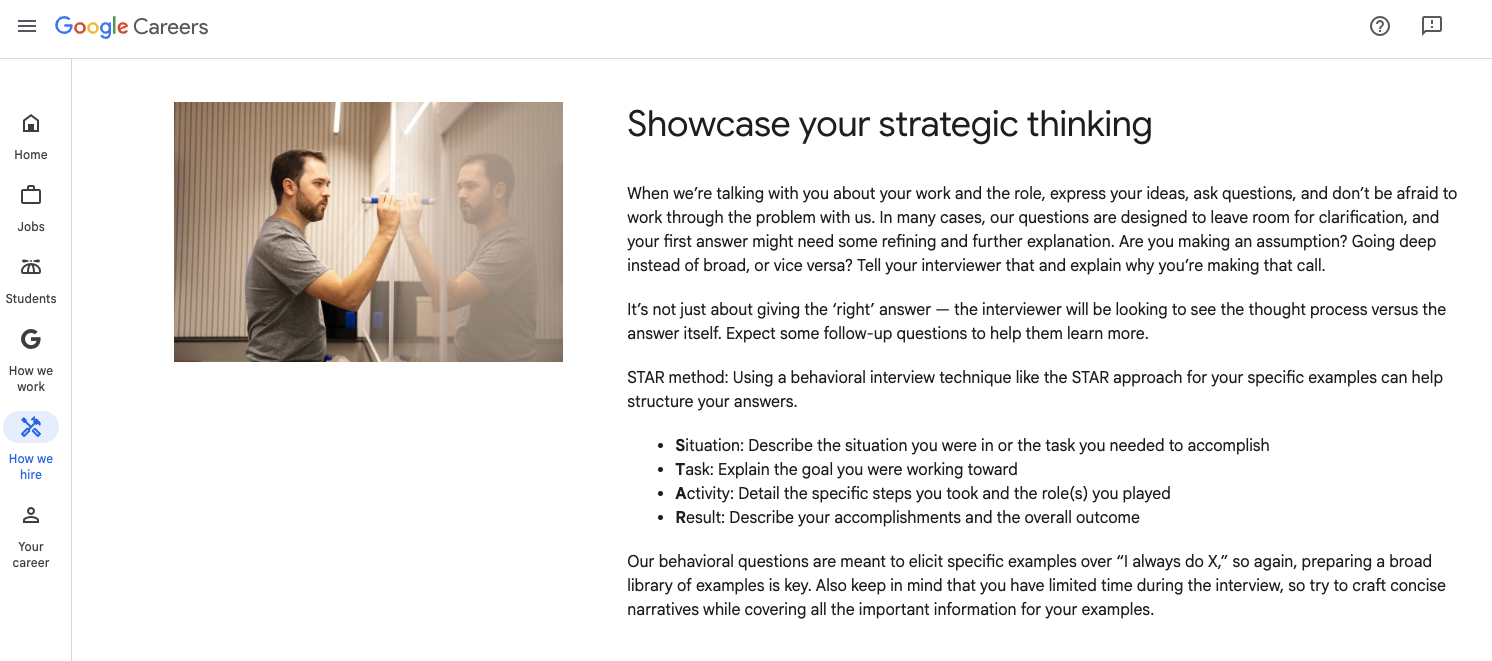
- Craft concise STAR stories showing both technical leadership and cultural fit: Google values teaching ability, so practice explaining complex topics simply.
The overall difficulty of FAANG interviews hinges on the candidate's strategic preparation.
Contribute to AGI development at DataAnnotation
AI training at platforms like DataAnnotation operates at the unlimited quality ceiling that FAANG companies value. If your background includes technical expertise, domain knowledge, or the critical thinking to evaluate complex trade-offs, this work positions you at the frontier of AI capabilities development.
DataAnnotation's coding projects, starting at $40+ per hour, connect you with the AI training frontier. Your evaluation judgments on code quality, algorithmic elegance, and edge case handling directly influence whether training runs advance model reasoning or optimize for the wrong objectives. Over 100,000 remote workers have contributed to this infrastructure.
If you want in, getting from interested to earning takes five straightforward steps:
- Visit the DataAnnotation application page and click "Apply"
- Fill out the brief form with your background and availability
- Complete the Starter Assessment, which tests your critical thinking and coding skills
- Check your inbox for the approval decision (typically within a few days)
- Log in to your dashboard, choose your first project, and start earning
No signup fees. DataAnnotation stays selective to maintain quality standards. You can only take the Starter Assessment once, so read the instructions carefully and review before submitting.
Apply to DataAnnotation if you understand why quality beats volume in advancing frontier AI — and you have the expertise to contribute.
.jpeg)