


In this article
Most remote work faces the same economic pressure: commoditization through automation and offshore competition. Customer service moves to chatbots. Data entry gets automated. Freelance writing competes with AI generation.
The race to the bottom feels inevitable.
AI training follows the opposite trajectory. As models get more sophisticated, the work becomes more complex rather than being automated. In 2020, annotators labeled sentiment as positive, negative, or neutral — a simple classification anyone could do.
By 2023, the work shifted to evaluating preference pairs in which annotators judged which AI response better demonstrated helpfulness or accuracy — requiring absolute judgments.
Now, frontier model training requires debugging multi-step reasoning chains, identifying where logic breaks down in complex proofs, and catching subtle errors that automated validators miss.
This pattern matters because it creates fundamentally different economics than typical remote work. The quality ceiling keeps rising. Your expertise becomes more valuable over time, not less. The work of training AI systems toward capabilities they haven't yet achieved can't be automated by those same systems.
This dynamic explains why AI training work offers remote benefits that other platforms can't match — not just flexibility and time savings, but a sustainable model in which complexity increases alongside compensation.
1. Earn financial benefits that scale with AI advancement
Remote work typically promises one thing: save on commuting costs and keep more of what you earn. The math is straightforward — avoid $2,000-5,000 on fuel and transit, $1,000-2,500 on meals, $500-1,500 on professional wardrobe. Most remote workers save $6,000-12,000 annually just by working from home.
But savings aren't growth. Most remote platforms pay flat rates regardless of expertise because they can't measure quality differences. When you're classified by task completion rather than judgment quality, everyone earns the same whether they're catching edge cases or pattern-matching from examples.
This creates the familiar race to the bottom: platforms compete on price, workers compete on volume, and compensation stagnates or declines as automation improves.
Beyond commute savings: The economics of increasing complexity
AI training work operates differently because platform technology measures quality in ways that justify expertise-based pricing.
DataAnnotation's tier structure ($25–$30+/hr for generalist work, up to $50-$75/hr for coding, and $50–$100+/hr for domain experts) reflects measurement systems that identify when workers demonstrate capabilities that general annotators don't provide and that automated validators can't verify.
Why sophistication trends upward, not toward commoditization
Consider what this means practically. A product manager in a role earning $25+ per hour on generalist projects is accessing work where demonstrated performance unlocks higher tiers over time.
As models advance and work complexity increases, the same expertise that earned $25–$30+/hr evaluating chatbot responses might qualify for up to $60/hr debugging reasoning chains or $50–$100+/hr evaluating domain-specific model outputs in specialized fields.
This scaling matters because most remote work trends toward commoditization. AI training work trends toward sophistication. The financial benefit isn't just keeping more of what you earn. It's building expertise that becomes more valuable as the technology advances, rather than watching your skills get automated or offshored.
2. Reclaim time for actual deep work, not just coordination
Skip the commute, and you reclaim 54 to 72 minutes daily according to U.S. Census Bureau data — roughly 225 to 300 hours annually. For most remote workers, this means more sleep, exercise, or family time. The benefit is real but generic: any work-from-home arrangement provides it.
What matters more is what you do with reclaimed time.
The hidden cost of coordination-heavy remote work
Most remote work still operates on coordination-heavy models: Slack messages requiring quick responses, Zoom meetings scheduled throughout the day, status updates and daily standups fragmenting attention into 15-minute blocks. You're not commuting, but you're not doing deep work either.
AI training work requires sustained focus that coordination-heavy remote work can't accommodate.
When you're evaluating whether an AI's reasoning chain actually supports its conclusion, or assessing whether code solutions create technical debt despite passing tests, you need uninterrupted blocks of cognitive effort. Some evaluations require 30 minutes of careful analysis. You can't do this work in the gaps between meetings.
Cognitive load management through uninterrupted blocks
At DataAnnotation, our meeting-free structure for AI trainers exists because the work demands it, not as a perk. We never assign fixed shifts or mandatory meetings because quality measurement happens through output analysis, not coordination rituals.
Workers choose their own hours (daily, weekly, whenever projects fit) because the work itself requires the kind of deep focus that scheduled interruptions destroy.
For instance, a marketing manager completing data analytics certification in the mornings while earning on DataAnnotation projects at night isn't just managing two schedules — they're allocating cognitive resources based on task demands.
Morning learning requires absorbing new frameworks. Evening annotation requires applying existing judgment. Both benefit from uninterrupted time blocks that coordination-heavy remote work makes impossible.
This creates a specific advantage: time reclamation that enables actual deep work rather than just eliminating commute time while maintaining office-style interruption patterns.
When a software engineer handles family breakfasts before day job responsibilities, then tackles coding projects earning up to $60/hr during evening peak focus hours, they're optimizing for cognitive load management in ways that meeting-heavy remote work prevents.
The practical difference: typical remote work gives you hours back but fills them with coordination overhead. AI training work gives you hours back for sustained cognitive effort — which is what the work requires.
3. Control your schedule around cognitive peaks, not office hours
Ask any parent managing school pickups and project deadlines about work-life balance, and you'll hear familiar frustration: the exhausting tug-of-war between competing demands, the guilt about stepping away mid-afternoon, the stress of explaining why you need flexible hours to managers who measure productivity by visible activity.
Remote work theoretically solves this. When you control your location, everyday logistics stop feeling like emergencies. You can handle school runs without commute buffers. You can attend medical appointments without burning vacation days.
But most remote platforms replicate office control mechanisms: required online hours, response-time expectations, and synchronous collaboration demands that make flexibility theoretical rather than practical.
The flexibility illusion in standard remote work
Consider what actually happens. A project manager negotiates remote work after having kids. They handle sprint planning from home and step away for school pickup — but they're expected to be online 9-to-5, available for impromptu meetings, and responsive to Slack within minutes.
The flexibility exists only within narrow boundaries that still create the same work-life conflicts, just from home instead of the office.
Asynchronous structure aligned with cognitive demands
AI training work operates differently because the cognitive demands don't fit coordination-heavy models. When you're spending 30 minutes evaluating whether an AI's reasoning chain supports its conclusion, you can't pause mid-analysis for a standup meeting.
When you're identifying edge cases in code evaluation that require understanding algorithmic implications, you can't fragment attention across Slack conversations. The work itself requires sustained focus that standard "flexible remote work" structures actively undermine.
At DataAnnotation, we offer genuine work-life integration because our work structure aligns with cognitive requirements. No fixed schedule means you work when you have sustained focus time — maybe mornings before family wakes, maybe late evenings after kids sleep, maybe in concentrated afternoon blocks when your mind is sharpest.
When project budgets tighten and hours get cut at your day job, AI training work at $25+ per hour fits around family life because we don’t require you to be available during specific hours or responsive within particular timeframes. Projects are purely asynchronous — complete them when you have cognitive capacity, not when a schedule demands your presence.
The practical difference: most "flexible" remote work adds location flexibility while maintaining office control structures. AI training work provides actual autonomy because the work itself requires it.
4. Build expertise that compounds value as AI advances
Remote work's dirty secret: most of it races toward automation or commoditization. Customer service jobs move to chatbots. Data entry gets automated through OCR and form recognition. Transcription services compete with speech-to-text algorithms. Freelance writing faces AI generation.
Even skilled work, such as basic programming, is increasingly automated through code-generation tools.
The pattern creates economic pressure.
The commoditization trap facing most remote platforms
As routine tasks are automated, the remaining work either requires sophisticated expertise or competes with offshore labor and algorithmic assistance on price.
Most remote work trends toward the latter: platforms aggregate workers globally, compensation falls to the lowest viable rates, and workers compete on volume rather than quality because platforms can't measure or verify expertise differences.
AI training follows the opposite trajectory, but understanding why requires recognizing what the work actually does. When you evaluate AI responses, debug reasoning chains, or assess code quality, you're not performing routine tasks that could be automated.
You're providing the feedback that trains models toward capabilities they don't yet have.
Training capabilities models don't yet possess
Right now, frontier model training towards AGI development requires debugging multi-step reasoning chains, identifying where logic breaks down in complex proofs, and catching errors that look syntactically correct but fail semantically.
The quality ceiling keeps rising. As models become more capable, the work becomes more sophisticated rather than being automated.
When you're evaluating whether an AI correctly applies domain expertise to novel situations, whether reasoning chains maintain logical consistency across multiple steps, or whether code solutions demonstrate algorithmic elegance rather than brute force approaches, you're performing evaluations that require the very capabilities we're trying to teach the models.
Rising sophistication versus automated replacement
For instance, a backend developer tackling programming projects on DataAnnotation earning up to $60/hr isn't competing with automation — they're training it.
Their expertise in recognizing when code creates technical debt, when algorithms are elegant rather than inefficient, or when solutions follow best practices becomes more valuable as models improve at generating syntactically correct code that still fails on these quality dimensions.
About 35 million people work remotely part-time in the U.S., but most face persistent questions about job security as automation improves. AI training faces the opposite dynamic: as AI capabilities advance, the work required to train systems toward next-level capabilities becomes more sophisticated and valuable rather than obsolete.
The distinction matters to anyone evaluating the sustainability of remote work. Most platforms offer flexibility now, but face pressure to commoditize over time. AI training platforms like DataAnnotation offer flexibility plus increasing sophistication as the technology advances — which changes the long-term value proposition entirely.
5. Develop capabilities through increasing work sophistication
Remote work gives you something no salary increase provides: time reclamation. Skip the commute, and you reclaim 72 minutes daily — over 200 hours annually that research shows gets reallocated to learning new skills, pursuing side projects, or professional development activities.
The conventional wisdom: use this time to pursue courses, certifications, or portfolio-building that advance your career.
But time reclamation alone doesn't guarantee growth.
Why reclaimed time alone doesn't guarantee development
Many remote workers find reclaimed hours get absorbed by household tasks, extended sleep, or leisure activities.
Professional growth requires intentional allocation, but coordination-heavy remote work makes this difficult when reclaimed commute time is filled with Slack messages, video meetings, and synchronous collaboration demands, fragmenting attention into unusable blocks.
Capability expansion through advancing work complexity
What matters more than reclaimed time is whether the work itself drives capability development. Most remote work involves performing known tasks more efficiently: customer service responses, data entry, routine programming, and content creation following established patterns.
You might get faster through practice, but you're not developing new capabilities because the work doesn't require them.
AI training follows different growth dynamics because the complexity of the work increases as models advance. The evaluations required for frontier model training right now are fundamentally more sophisticated than the 2023 work, which was more complex than the 2020 tasks.
As models become more capable, the feedback needed to push them to the next level requires more profound expertise and more nuanced judgment.
Evaluating AI reasoning chains teaches systematic thinking, and assessing code quality helps build mental models of algorithmic elegance.
Compound growth from sophistication increases
Consider career trajectory implications. Conventional remote work advice: work more hours to earn more money. AI training work reality: deepen expertise to access work where the quality ceiling is unlimited.
Workers earning $50+ per hour for professional work might not work longer hours than $25–$30/hour generalist workers — they're accessing projects where domain expertise catches errors that cost AI companies millions in wasted training runs.
As models get more capable, this work becomes more valuable because the gap between "passing automated checks" and "actually advancing model capabilities" widens. The professional growth comes from increasing work sophistication, not just from time reclamation, enabling separate learning activities.
The distinction: most remote work gives you time back for separate professional development. AI training work provides time back and increases the sophistication of the work itself, creating compound growth that static remote work can't match.
Who qualifies for AI training work?
The data annotation market is projected to grow at 26% annually through 2030, driven by expanding AI capabilities that require increasingly sophisticated training data. But growth obscures a fundamental split in the industry: body shops scaling commodity labor versus technology platforms scaling expertise.
At DataAnnotation, AI training isn't mindless data entry. It's not a side hustle. We believe it's the bottleneck to AGI. Every frontier model depends on human intelligence that algorithms cannot replicate. As models become more capable, this dependence intensifies rather than diminishes.
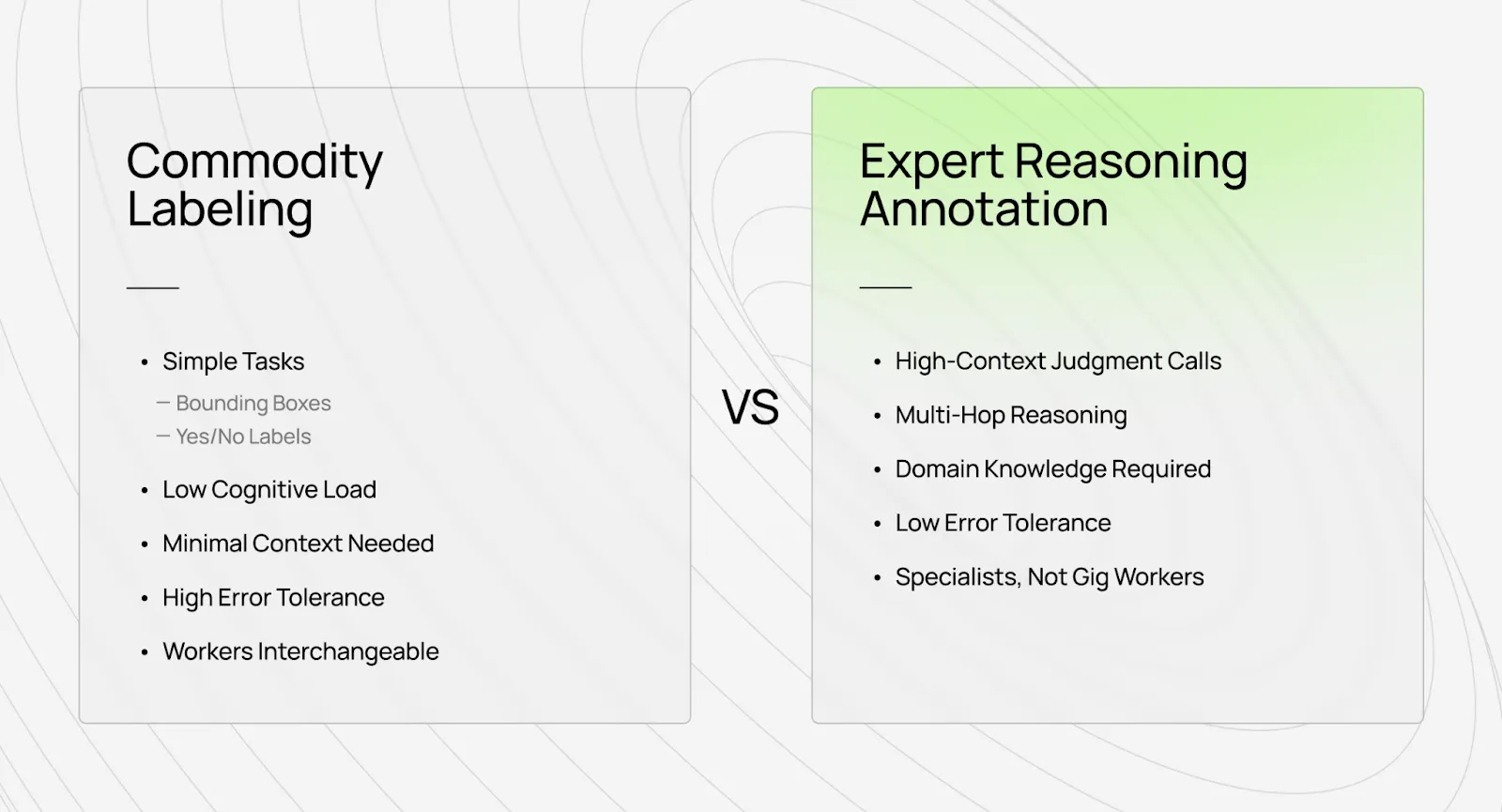
If you have genuine expertise (coding ability, STEM knowledge, professional credentials, or exceptional critical thinking), you can help build the most important technology of our time at DataAnnotation.
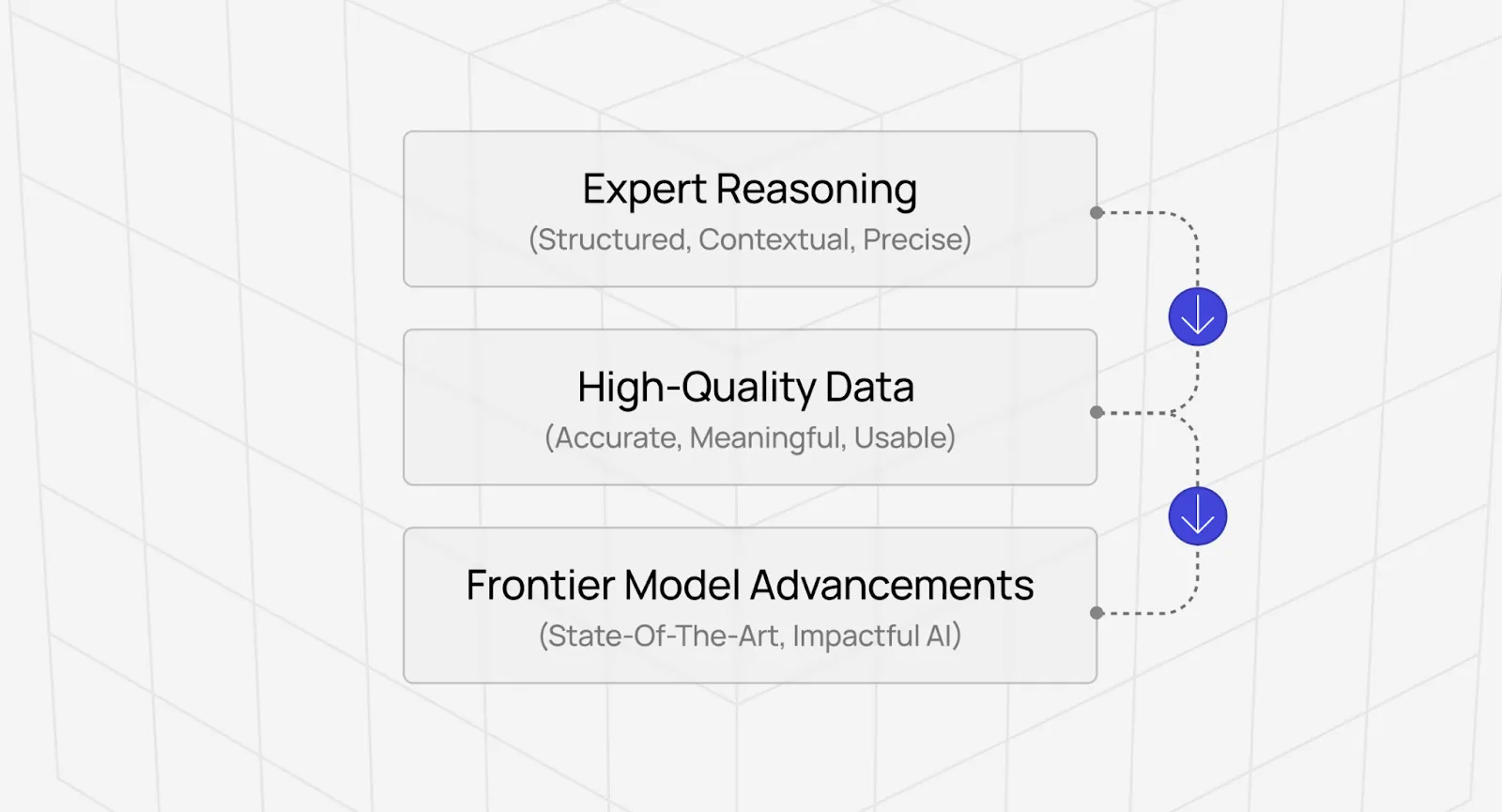
Quality AI training work is for:
Domain experts who want their expertise to matter: For instance, computational chemists who are tired of pharmaceutical roles where their knowledge gets underutilized. Mathematicians seeking intellectual engagement beyond teaching introductory calculus. Programmers who want to apply their craft to advancing AI rather than debugging legacy enterprise software.
Professionals who need flexible income without sacrificing intellectual standards: For example, the researcher awaiting grant funding who can contribute to frontier model training while maintaining their primary focus. The attorney with reduced hours who can apply legal reasoning to AI safety problems. The STEM professional who needs work without geographic constraints.
Creative professionals who understand craft: Examples include writers who can distinguish between generic AI prose and genuinely compelling narratives. Poets who recognize that technique without creativity produces mediocre work, regardless of formal training.
People who care about contributing to AGI development: Workers who understand that training frontier models matters more than optimizing their personal hourly rate. Experts recognize that their knowledge becomes exponentially more valuable when transferred to AI systems that operate at scale.
The poetry you write serves as a model for creativity and language. The code you evaluate helps them learn software engineering judgment. The scientific reasoning you demonstrate advances their capability to assist with research.
How to get an AI training job?
At DataAnnotation, we operate through a tiered qualification system that validates expertise and rewards demonstrated performance.
Entry starts with a Starter Assessment that typically takes about an hour to complete. This isn't a resume screen or a credential check — it's a performance-based evaluation that assesses whether you can do the work.
Pass it, and you enter a compensation structure that recognizes different levels of expertise:
- General projects: $25–$30+/hr for evaluating chatbot responses, comparing AI outputs, and writing challenging prompts
- Multilingual projects: $20–$30+/hr for translation and localization work across many languages
- Coding projects: Earn up to $50-$75+/hr for code evaluation and AI performance assessment across Python, JavaScript, HTML, C++, C#, SQL, and other languages
- STEM projects: $50–$100+/hr for domain-specific work requiring a completed or in-progress bachelor’s degree through PhD-level knowledge in mathematics, physics, biology, and chemistry
- Professional projects: $50–$100+/hr for specialized work requiring credentials in law, finance, or medicine
Once qualified, you select projects from a dashboard showing available work that matches your expertise level. Project descriptions outline requirements, expected time commitment, and specific deliverables.
You can choose your work hours. You can work daily, weekly, or whenever projects fit your schedule. There are no minimum hour requirements, no mandatory login schedules, and no penalties for taking time away when other priorities demand attention.
The work here at DataAnnotation fits your life rather than controlling it.
Explore AI training work at DataAnnotation today
The gap between models that pass benchmarks and those that work in production lies in the quality of the training data. If your background includes technical expertise, domain knowledge, or the critical thinking to spot what automated systems miss, AI training at DataAnnotation positions you at the frontier of AI development.
Not as a button-clicker earning side income, but as someone whose judgment determines whether billion-dollar training runs advance capabilities or learn to optimize the wrong objectives.
Getting from interested to earning takes five straightforward steps:
- Visit the DataAnnotation application page and click “Apply”
- Fill out the brief form with your background and availability
- Complete the Starter Assessment, which tests your critical thinking and attention to detail
- Check your inbox for the approval decision (which should arrive within a few days)
- Log in to your dashboard, choose your first project, and start earning
No signup fees. We stay selective to maintain quality standards. Just remember: you can only take the Starter Assessment once, so prepare thoroughly before starting.
Apply to DataAnnotation if you understand why quality beats volume in advancing frontier AI — and you have the expertise to contribute.

Phoebe is a California native currently based in Vermont. When she's not working, she enjoys traveling, playing drums, writing songs, and exploring the outdoors. With a background in public health and clinical research, Phoebe built a successful career in project management across both public and private sectors before joining DataAnnotation. She's excited to contribute to the platform's growth and its role in shaping the future of AI.

Get ahead in a changing workforce.
No recruiters. No interviews. Just meaningful work and real compensation.