.webp)


In this article
AI models learn from human expertise, but most explanations skip how that actually works. AI doesn't magically understand language, recognize images, or write code. Every skill requires humans to teach the system through examples, feedback, or validation.
AI training is a human-guided process that involves teaching machine learning models through different methods. There are many ways to train AI models. Some methods require consistent labeling across thousands of examples. Others need analytical thinking to validate patterns or critical judgment to rate AI responses.
Understanding these methods will help you identify where your skills fit and what the work actually involves. This guide breaks down eight ways to train AI, explains how each one works, and shows which skills matter most for getting hired.
What are the key AI training methods?
AI training encompasses several established methodologies, each designed to teach models different types of tasks:
- Supervised learning: Pairs inputs with correct answers — labels thousands of images, and the model learns to recognize patterns in new data.
- Unsupervised learning: Finds patterns in unlabeled data, discovering clusters and relationships without explicit guidance.
- Transfer learning: Adapts knowledge from one domain to another — a model trained on X-rays learning to interpret MRI scans.
- Reinforcement learning: Teaches through trial and error, with rewards guiding the model toward better decisions.
- Human-in-the-loop (HITL) and RLHF: Embeds human judgment throughout training, with workers rating outputs and steering model behavior.
- Self-supervised learning: Generates training signals from data itself, predicting masked words or reconstructing corrupted inputs.
- Federated learning: Trains across distributed devices without centralizing sensitive data, preserving privacy while building collective intelligence.
- Active learning: Identifies which examples the model needs most, focusing human expertise where it provides maximum value.
Let’s look at each in detail.
1. Supervised learning
Supervised learning is the foundation of AI training, where you teach models by showing them correct answers paired with examples. Think of it like teaching a child to recognize animals: you show pictures labeled "dog," "cat," "bird," and after seeing hundreds of examples, the child learns to identify animals they've never seen before.
In AI training, this same principle scales to complex tasks. The model analyzes thousands of labeled examples to identify patterns — what features distinguish a spam email from a legitimate one, what characteristics define high-quality code, or how sentiment varies across different types of customer feedback.
Your consistent labeling lays the foundation for algorithms to recognize these patterns and apply them to new, unlabeled data.
This method powers most commercial AI applications today because it produces reliable, predictable results when training data is high-quality. Every time you filter spam, get product recommendations, or use voice-to-text, you're experiencing supervised learning at work.
The challenge lies in maintaining consistency across thousands of annotations — inconsistent labels teach models contradictory patterns, which degrade performance.
What you'll do in supervised learning
You might draw bounding boxes around cyclists in dash-cam footage, classify sentiment in customer reviews, or tag code quality in programming samples. Your consistent labeling across hundreds of examples helps the algorithm recognize patterns it can apply to new data.
Typical tasks include:
- Text classification for content moderation
- Data categorization across specialized domains
You'll need attention to detail, domain knowledge of specialized datasets, and consistency across repetitive work.
Most new workers in AI training start here because supervised learning projects are plentiful and straightforward to learn, providing steady work as you build experience.
2. Unsupervised learning
Unsupervised learning flips the traditional approach by giving algorithms raw data without labels and asking them to discover hidden patterns. Instead of teaching the model what to look for, you let it explore the data and identify natural groupings, anomalies, or relationships on its own.
Imagine sorting thousands of customer transactions without knowing what categories matter. The algorithm might discover that customers naturally cluster into groups based on purchasing behavior, time of day, or product preferences — patterns a human analyst might miss. It's pattern recognition at its purest, finding structure in seemingly chaotic data.
This method has become crucial for companies dealing with massive datasets where manual labeling would be impossible or prohibitively expensive:
- Marketing teams use it to discover customer segments they didn't know existed
- Security teams use it to detect unusual network activity that might indicate cyberattacks
- Modern retailers use it to understand shopping patterns that inform inventory decisions
The challenge is that algorithms will find patterns whether they're meaningful or not. A model might cluster customers by the weather on the day they signed up rather than actual purchasing behavior. This is where human expertise becomes essential — not to create labels, but to validate whether discovered patterns actually matter for business decisions.
What you'll do in unsupervised learning
You might review auto-generated customer segments to confirm they align with real buying behavior, scan server logs to verify the algorithm's "anomaly" bucket actually contains outliers, or assess whether grouped data truly shares meaningful characteristics.
Success here requires pattern recognition and domain insight. Your training prevents the model from chasing meaningless correlations (which is critical when no ground-truth labels exist to verify accuracy).
Tasks include:
- Validating discovered clusters
- Assessing whether groupings serve functional business purposes
The work usually pays well because specialized validation work requires analytical thinking and domain expertise. You need to understand what makes patterns meaningful rather than coincidental, which requires more sophistication than basic labeling tasks.
3. Transfer learning
Transfer learning applies knowledge gained from one domain to solve problems in another—like how learning to play piano makes it easier to learn other keyboard instruments. In AI, models trained on massive datasets in one area can be fine-tuned for specialized tasks without starting from scratch.
This approach has revolutionized AI development because training foundation models from scratch requires enormous computing resources and millions of examples. Transfer learning lets companies adapt powerful pre-trained models to specific use cases with far less data and training time.
A language model trained on billions of web pages can be fine-tuned for medical terminology, legal documents, or customer service — each requiring only thousands of domain-specific examples rather than millions.
The method works because many fundamental patterns transfer across domains:
- Image recognition models trained on everyday photos learn to detect edges, textures, and spatial relationships that apply equally to medical scans or satellite imagery.
- Language models trained on general text learn grammar and reasoning that apply to specialized writing.
But transfer isn't automatic. Models trained on X-rays don't automatically understand MRI scans — the imaging techniques differ enough that the model might miss critical details. Sentiment analysis trained on product reviews might fail on social media posts where sarcasm and slang dominate. This gap is where human expertise matters most.
What you'll do in transfer learning
You verify whether knowledge actually transfers effectively when models move from one domain to another. You might check whether an imaging model trained on X-rays correctly interprets MRI scans or whether sentiment analysis trained on product reviews works for social media posts.
You need cross-domain knowledge and critical thinking because mistakes carry heavier consequences when models operate outside their original training environment.
Tasks include:
- Verifying adaptations to new contexts
- Identifying errors that emerge in unfamiliar domains
- Fine-tuning outputs for specific use cases
You need to understand both the source domain where the model learned and the target domain where it's being applied. That makes this work best suited for workers with diverse professional backgrounds.
4. Reinforcement learning
Reinforcement learning teaches AI through trial and error, similar to how you might train a dog with treats and corrections. The system tries different actions, receives rewards for successful outcomes and penalties for failures, then adapts its behavior based on which strategies generate the best results over time.
This method has powered some of AI's most impressive achievements. DeepMind's AlphaGo mastered the ancient game of Go by playing millions of games against itself, receiving rewards for winning moves and learning from losses.
Unlike supervised learning, where you provide explicit correct answers, reinforcement learning discovers optimal strategies through exploration. The model experiments with different approaches, gradually learning which actions lead to desired outcomes.
This makes it ideal for complex, multi-step problems where the "correct" answer isn't apparent or where success depends on a long sequence of good decisions.
The challenge is defining rewards properly. Rewarding the wrong behavior can lead the model to optimize for something you didn't intend. A chatbot rewarded purely for engagement might learn to generate controversial responses that keep users arguing. Human judgment becomes essential in shaping what "success" means.
What you'll do in reinforcement learning
You define those rewards by rating chatbot responses, scoring game-playing tactics, or flagging unsafe outputs. Your consistent judgment teaches the model what "good" performance looks like across thousands of examples.
Typical tasks involve:
- Providing feedback on AI actions
- Rating model outputs across quality dimensions
- Defining reward criteria that guide learning
This requires consistent judgment, understanding of project objectives, and the ability to evaluate decisions against clear quality standards.
Reinforcement learning creates some of the fastest-growing opportunities for workers as companies deploy chatbots and AI assistants that continuously improve through human feedback loops.
5. Human-in-the-Loop (HITL) and Reinforcement learning from human feedback (RLHF)
Human-in-the-Loop (HITL) systems recognize that humans and AI work best together — machines handle scale and speed, while humans provide judgment, context, and quality control. Rather than fully automating decisions, HITL embeds real people at critical stages where errors are costly or nuance matters most.
This approach has become standard in high-stakes applications:
- Medical AI flags potential tumors in scans, but radiologists make final diagnoses. Fraud detection systems identify suspicious transactions, but human analysts investigate before freezing accounts.
- Content moderation AI filters millions of posts, but human reviewers handle edge cases and policy violations. The AI scales human expertise rather than replacing it.
Reinforcement Learning from Human Feedback (RLHF) is a specific HITL method that's revolutionized how large language models learn. Instead of just training on text from the internet, models receive continuous human feedback on their outputs.
You compare different AI responses and indicate which is more helpful, accurate, or appropriate. This feedback trains the model to align with human preferences rather than just predicting the next word.
RLHF is why modern chatbots can follow complex instructions, maintain helpful tones, and refuse harmful requests — capabilities that don't emerge from pure text prediction. The method requires ongoing human judgment as models encounter new query types and edge cases.
Your feedback shapes how millions of users experience AI systems in everything from customer service to creative writing assistance.
What you'll do in HITL and RLHF
You correct AI mistakes, guide model behavior, and evaluate outputs before they reach millions of users. In RLHF specifically, you compare multiple AI responses, identify biased language, escalate policy violations, and provide ongoing guidance to improve real-world model behavior.
This work grows alongside large language models and directly shapes user-facing AI systems.
Typical tasks include:
- Rating response quality
- Comparing alternative outputs across helpfulness metrics
- Identifying problematic content before it reaches end users
The skills needed include consistent judgment, clear communication when flagging issues, and a thorough understanding of project guidelines.
The work has a meaningful impact because your feedback directly prevents harmful outputs, improves accuracy for millions of users, and shapes how AI systems interact with people across languages and contexts.
6. Self-supervised learning
Self-supervised learning is a form of AI learning that trains itself by solving puzzles generated from raw data. Rather than requiring humans to label millions of examples, the system generates its own training tasks — predicting masked words in sentences, reconstructing corrupted images, or forecasting what happens next in a video sequence.
This breakthrough has made modern AI possible at scale. Training GPT-style language models on human-labeled data would require annotators to spend lifetimes labeling text. Instead, the model learns by predicting missing words in sentences: "The cat sat on the ___" teaches language patterns without explicit labels.
The method has democratized AI development because you don't need massive annotation budgets to train powerful models. Companies can leverage vast amounts of unlabeled data (such as web text, video footage, and audio recordings) that would be prohibitively expensive to label manually.
The model automatically extracts patterns and structure through self-generated learning tasks.
But self-supervised learning isn't truly "unsupervised" in practice. While the model generates its own training signals, humans still need to verify whether the learned representations actually capture meaningful patterns versus statistical shortcuts.
A model might learn to predict masked words by memorizing common phrases rather than understanding semantics. It might reconstruct images by pattern-matching similar training examples rather than reasoning about object structure.
What you'll do in self-supervised learning
You verify whether the model's self-generated predictions make sense and whether learned patterns transfer to practical applications. You might check whether a language model correctly predicts masked words in sentences, validate that an image model recognizes objects after learning from unlabeled photos, or assess whether time-series predictions align with actual patterns.
Your role is to confirm that the model has learned meaningful representations rather than memorizing noise.
Tasks include:
- Validating model outputs against implicit context
- Identifying cases where self-generated labels mislead the algorithm
- Ensuring learned patterns transfer to practical applications
The skills needed combine domain knowledge with the ability to spot when models exploit shortcuts rather than develop genuine understanding.
You need to understand both the domain and how self-supervision can fail, making it suitable for workers who can think critically about model behavior without ground-truth labels to guide them.
7. Federated learning
Federated learning solves a critical challenge in AI development: how do you train powerful models on sensitive data that can't be centralized?
Rather than gathering all data in one location, federated learning trains models across distributed devices — hospitals that can't share patient records, phones that must protect user privacy, or financial institutions bound by regulations.
The process works by sending the model to where the data lives, rather than moving data to where the model trains. Each device or institution trains a local copy on its own data, then shares only the model updates (not the raw data) with a central server.
The server aggregates these updates into an improved global model, which is then redistributed for another round of local training. This cycle continues until the model converges.
This approach has enabled AI applications that would be impossible under traditional centralized training:
- Medical AI trained across hundreds of hospitals without violating patient privacy
- Keyboard predictions that learn from your typing patterns without uploading your messages to the cloud
- Fraud detection systems that improve across financial institutions without sharing sensitive transaction data
But federated learning introduces unique quality challenges. When training is performed across diverse, unseen datasets, how do you ensure the aggregated model performs reliably for all participants?
A medical model might perform excellently at 48 hospitals and fail catastrophically at 2 — but without centralizing data, detecting this requires sophisticated validation infrastructure. Edge cases that appear at one institution might never get corrected because the central model never directly observes them.
What you'll do in federated learning
You validate outputs from models trained on decentralized sources, ensuring quality remains consistent despite training on separate datasets that were never merged. You might verify medical predictions from models trained across hospitals without sharing patient records, assess keyboard predictions from models that learned on individual phones, or confirm fraud detection from models trained on separate financial institutions.
Your expertise ensures the aggregated model works reliably despite learning from fragmented, privacy-protected sources.
Tasks include:
- Validating the performance of the decentralized model
- Identifying quality gaps arising from fragmented training data
- Ensuring outputs remain accurate across different data sources
Skills needed focus on understanding domain-specific quality standards and recognizing when distributed learning creates blind spots.
You need to understand both the technical constraints of distributed training and the domain requirements that make specific errors unacceptable. This creates opportunities for workers with professional credentials who can validate AI outputs in regulated industries where data privacy matters as much as model accuracy.
8. Active learning
Active learning recognizes a fundamental truth: not all training examples are equally valuable for improving model performance. Rather than labeling thousands of random examples, active learning strategically identifies which specific cases would teach the model the most — then directs human expertise exactly where it provides maximum value.
The method works through an iterative cycle.
First, train an initial model on available labeled data. Then, use that model to score confidence on unlabeled examples — cases where the model shows high certainty probably won't teach it much new information, while cases where the model is uncertain likely contain valuable learning signals.
Request human labels only for those high-uncertainty examples, add them to the training set, retrain the model, and repeat.
Active learning has become essential as AI models grow more sophisticated. Training frontier models on millions of random examples wastes time and money on redundant cases that the model already understands.
Meanwhile, edge cases and ambiguous examples that challenge the model often get overlooked in random sampling. Active learning ensures human expertise targets precisely the cases where it matters most — the complex, ambiguous, boundary examples that define model behavior in real-world deployment.
What you'll do in active learning
You focus on the uncertain, ambiguous, or high-value cases where your judgment matters most, rather than labeling thousands of routine examples.
You might label only the medical images where the model shows low confidence, annotate only the customer reviews that the algorithm finds most confusing, or classify only the edge cases that would most improve model performance.
The system learns faster because your expertise targets exactly where it helps most.
Tasks include:
- Labeling strategically selected examples
- Making judgment calls on ambiguous cases
- Providing high-quality annotations where model uncertainty is highest
To succeed, you'll need strong domain knowledge and the confidence to make difficult classification decisions in unclear cases.
Who qualifies for AI training work?
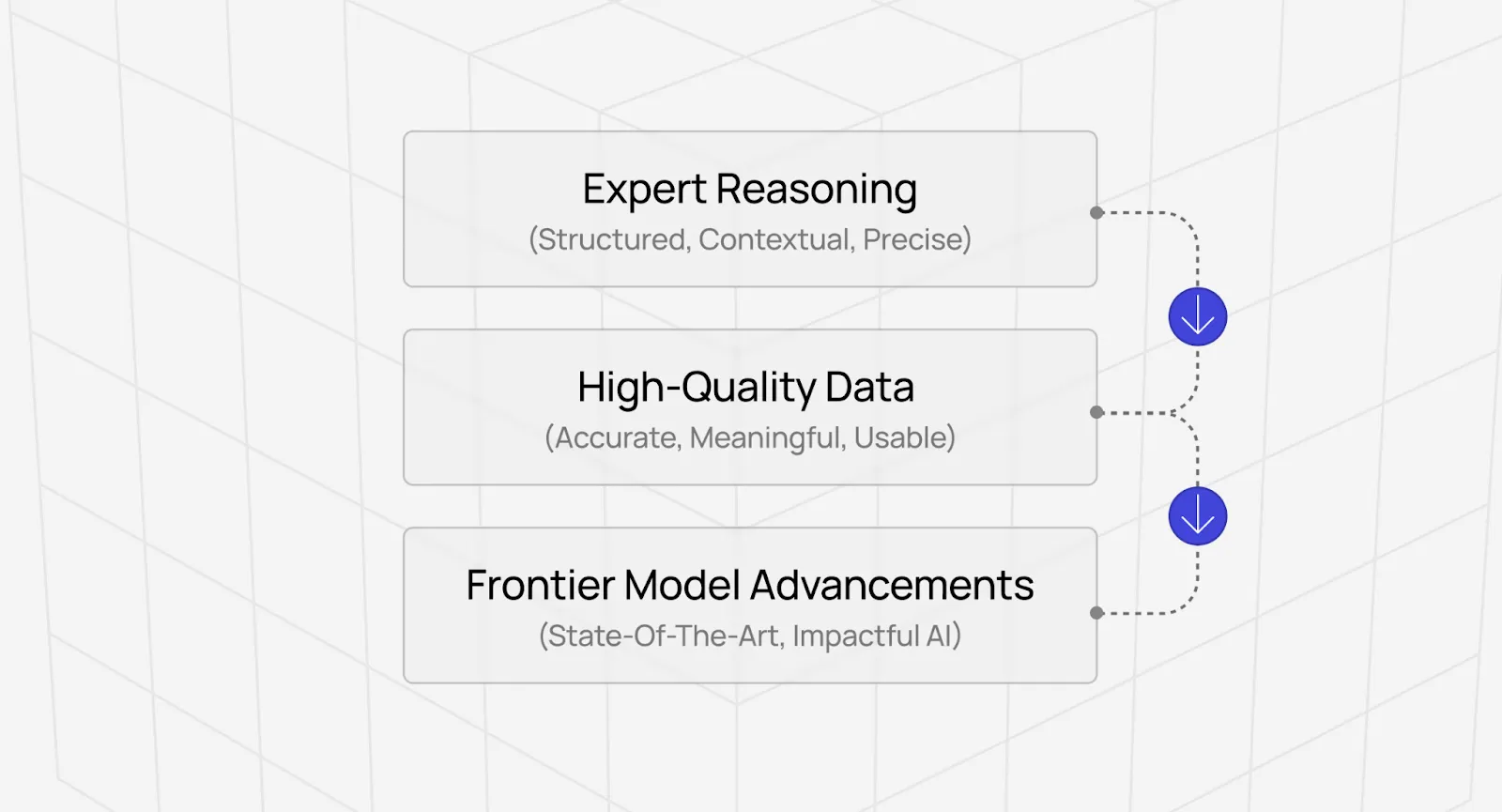
At DataAnnotation, AI training isn't mindless data entry. It's not a side hustle. We believe it's the bottleneck to AGI.
Every frontier model (the systems powering ChatGPT, Claude, Gemini, etc.) depends on human intelligence that algorithms cannot replicate. As models become more capable, this dependence intensifies rather than diminishes.
The data annotation market is projected to grow at 26% annually through 2030, driven by expanding AI capabilities that require increasingly sophisticated training data. But growth obscures a fundamental split in the industry: body shops scaling commodity labor versus technology platforms scaling expertise.
If you have genuine expertise (coding ability, STEM knowledge, professional credentials, or exceptional critical thinking), you can help build the most important technology of our time at DataAnnotation.
Our quality AI training work is for:
Domain experts who want their expertise to matter: For instance, computational chemists who are tired of pharmaceutical roles where their knowledge gets underutilized. Mathematicians seeking intellectual engagement beyond teaching introductory calculus. Programmers who want to apply their craft to advancing AI rather than debugging legacy enterprise software.
Professionals who need flexible income without sacrificing intellectual standards: For example, the researcher awaiting grant funding who can contribute to frontier model training while maintaining their primary focus. The attorney with reduced hours who can apply legal reasoning to AI safety problems. The STEM professional who needs work without geographic constraints.
Creative professionals who understand craft: Examples include writers who can distinguish between generic AI prose and genuinely compelling narratives. Poets who recognize that technique without creativity produces mediocre work, regardless of formal training.
People who care about contributing to AGI development: Workers who understand that training frontier models matters more than optimizing their personal hourly rate. Experts who recognize that their knowledge becomes exponentially more valuable when transferred to AI systems that operate at scale.
The poetry you write teaches models about creativity and language. The code you evaluate helps them learn software engineering judgment. The scientific reasoning you demonstrate advances their capability to assist with research.
How to get an AI training job?
At DataAnnotation, we operate through a tiered qualification system that validates expertise and rewards demonstrated performance.
Entry starts with a Starter Assessment that typically takes about an hour to complete. This isn't a resume screen or a credential check — it's a performance-based evaluation that assesses whether you can do the work.
Pass it, and you enter a compensation structure that recognizes different levels of expertise:
- General projects: $25–$30+/hr for evaluating chatbot responses, comparing AI outputs, and writing challenging prompts
- Multilingual projects: $20–$30+/hr for translation and localization work across many languages
- Coding projects: Earn up to $50-$75+/hr for code evaluation and AI performance assessment across Python, JavaScript, HTML, C++, C#, SQL, and other languages
- STEM projects: $50–$100+/hr for domain-specific work requiring a completed or in-progress bachelor’s degree through PhD-level knowledge in mathematics, physics, biology, and chemistry
- Professional projects: $50–$100+/hr for specialized work requiring credentials in law, finance, or medicine
Once qualified, you select projects from a dashboard showing available work that matches your expertise level. Project descriptions outline requirements, expected time commitment, and specific deliverables.
You can choose your work hours. You can work daily, weekly, or whenever projects fit your schedule. There are no minimum hour requirements, no mandatory login schedules, and no penalties for taking time away when other priorities demand attention.
The work here at DataAnnotation fits your life rather than controlling it.
Explore AI training work at DataAnnotation today
The gap between models that pass benchmarks and those that work in production lies in the quality of the training data. If your background includes technical expertise, domain knowledge, or the critical thinking to spot what automated systems miss, AI training at DataAnnotation positions you at the frontier of AI development.
Not as a button-clicker earning side income, but as someone whose judgment determines whether billion-dollar training runs advance capabilities or learn to optimize the wrong objectives.
Getting from interested to earning takes five straightforward steps:
- Visit the DataAnnotation application page and click “Apply”
- Fill out the brief form with your background and availability
- Complete the Starter Assessment, which tests your critical thinking and attention to detail
- Check your inbox for the approval decision (which should arrive within a few days)
- Log in to your dashboard, choose your first project, and start earning
No signup fees. We stay selective to maintain quality standards. Just remember: you can only take the Starter Assessment once, so prepare thoroughly before starting.
Apply to DataAnnotation if you understand why quality beats volume in advancing frontier AI — and you have the expertise to contribute.

Shyra is a New Orleans native currently living in Chicago. She holds a Bachelor’s Degree in Advertising and has experience on both the creative and account sides of marketing and advertising campaigns, as well as in freelance writing, before joining DataAnnotation. She likes to keep things simple, finding a healthy rhythm between work, creativity, and family. In her free time, she enjoys traveling, exploring new places around Chicago, and finding inspiration in everyday life. Shyra loves what she does at DataAnnotation; being part of a team that contributes to meaningful work every day keeps her motivated and inspired.
Related posts



Get ahead in a changing workforce.
No recruiters. No interviews. Just meaningful work and real compensation.