
Full-stack developers and software engineers approach problems differently. One sees the entire system — how frontend choices cascade into backend complexity, how user experience shapes data architecture. The other goes deeper into specific domains — algorithmic efficiency, distributed systems, performance optimization.
Most discussions frame this as a career choice: which path maximizes your salary or opens more doors? That's the wrong question.
The better question? Does the distinction even matter anymore when AI can implement both approaches in seconds?
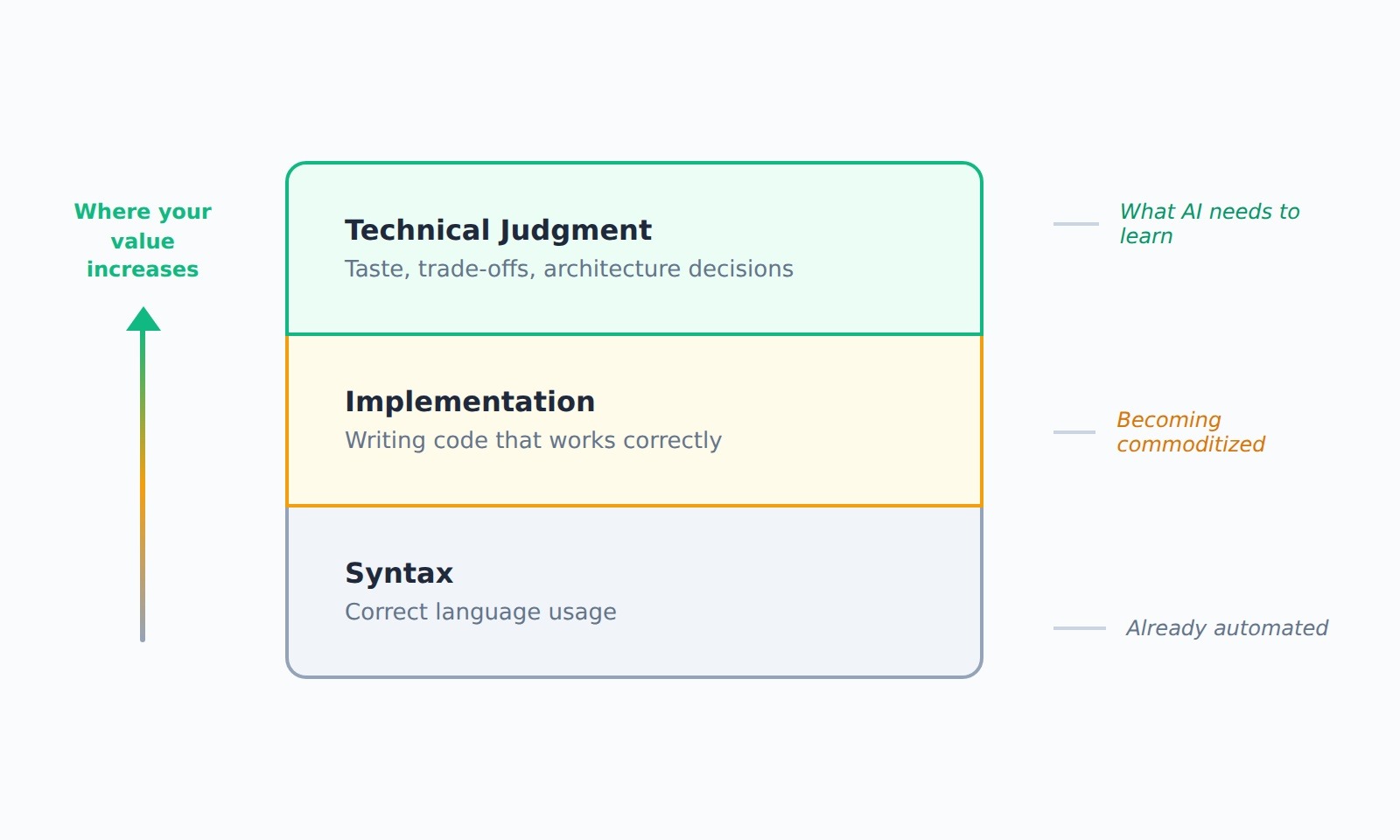
The traditional career comparison misses what's actually happening in software development. Implementation speed (the skill that once mattered) is becoming commoditized. Technical judgment isn't.
We've spent the past several years working with thousands of developers and engineers evaluating AI-generated code for frontier model training. What we've learned challenges conventional wisdom about both fields — and reveals why your choice now matters less than your ability to recognize quality code when you see it.
But first, let's start with the core differences between these two technical fields.
What are the differences between a full-stack developer and a software engineer?
The fundamental split between these career paths centers on scope and depth.
Full-stack developers trade specialization for versatility across the entire application stack, while software engineers invest their energy into mastering specific technical domains:
Technical breadth and depth
Full-stack developers navigate between JavaScript, HTML, CSS, server-side languages like Python or Node.js, and databases spanning SQL to NoSQL, all within the same sprint cycle. This versatility makes them effective problem solvers for modern web teams needing rapid cross-stack execution.
Software engineers concentrate their efforts differently. They perfect microservice architectures, optimize high-performance algorithms, or master embedded systems, depending on the company’s requirements.
The distinction shapes daily work fundamentally. If you find fulfillment in variety and rapid problem pivoting, full-stack work aligns naturally with your interests. If mastering one craft until you understand every nuance drives you, specialized engineering provides that depth.
Both paths share one constant: the AI training skills that matter most, such as reading code, evaluating quality, and understanding logic, don't expire like framework knowledge does. These core competencies transfer across roles, stacks, and even industries.
Collaboration and team dynamics
As a full-stack developer, you constantly bridge between designers, product managers, and infrastructure teams. Cross-functional collaboration rewards communication skills as much as technical ability. You also translate business requirements into technical implementation while explaining technical constraints to non-technical stakeholders.
Software engineers collaborate intensively too, but typically within domain-specific squads where conversations focus on performance benchmarks, design patterns, and architectural trade-offs.
Skills and responsibilities
The core difference in daily work comes down to breadth versus depth.
Full-stack developers constantly switch context between frontend interfaces, backend services, and database operations — often within the same day. This requires working knowledge across the entire application stack:
- End-to-end feature delivery: Take a product requirement and implement it from UI mockup through API design to database schema, handling authentication, validation, and error states across all layers.
- Cross-platform execution: Build responsive interfaces that work across browsers and devices while ensuring the backend can handle the load and data consistency requirements.
- Rapid prototyping: Ship working features quickly by leveraging frameworks and tools across the stack, optimizing for delivery speed over specialized performance.
Software engineers invest their time differently — going deeper into specific technical domains rather than broader across layers:
- System architecture: Design distributed systems that scale to millions of users, choosing appropriate data structures, algorithms, and infrastructure patterns based on specific performance requirements.
- Performance optimization: Profile applications to find bottlenecks, then optimize critical code paths using advanced algorithms, caching strategies, or lower-level language features.
- Domain specialization: Master areas like machine learning infrastructure, embedded systems, or real-time data processing — problems that require deep technical expertise rather than full-stack versatility.
Both roles require strong programming fundamentals and Git workflows. The distinction lies in whether you're solving problems by quickly connecting different technologies (full-stack) or by deeply mastering specific technical domains (engineering).
These fundamentals (debugging ability, code quality assessment, and security awareness) are exactly what data annotation work requires when evaluating AI-generated code. The same instincts that make you valuable in either role translate directly to AI training.
Career paths and specialization
The median hourly rate for full-stack developers is $25; for software engineers, it is $20. If you enjoy creative collaboration and direct impact on what users see, a full-stack development team structure is a good fit.
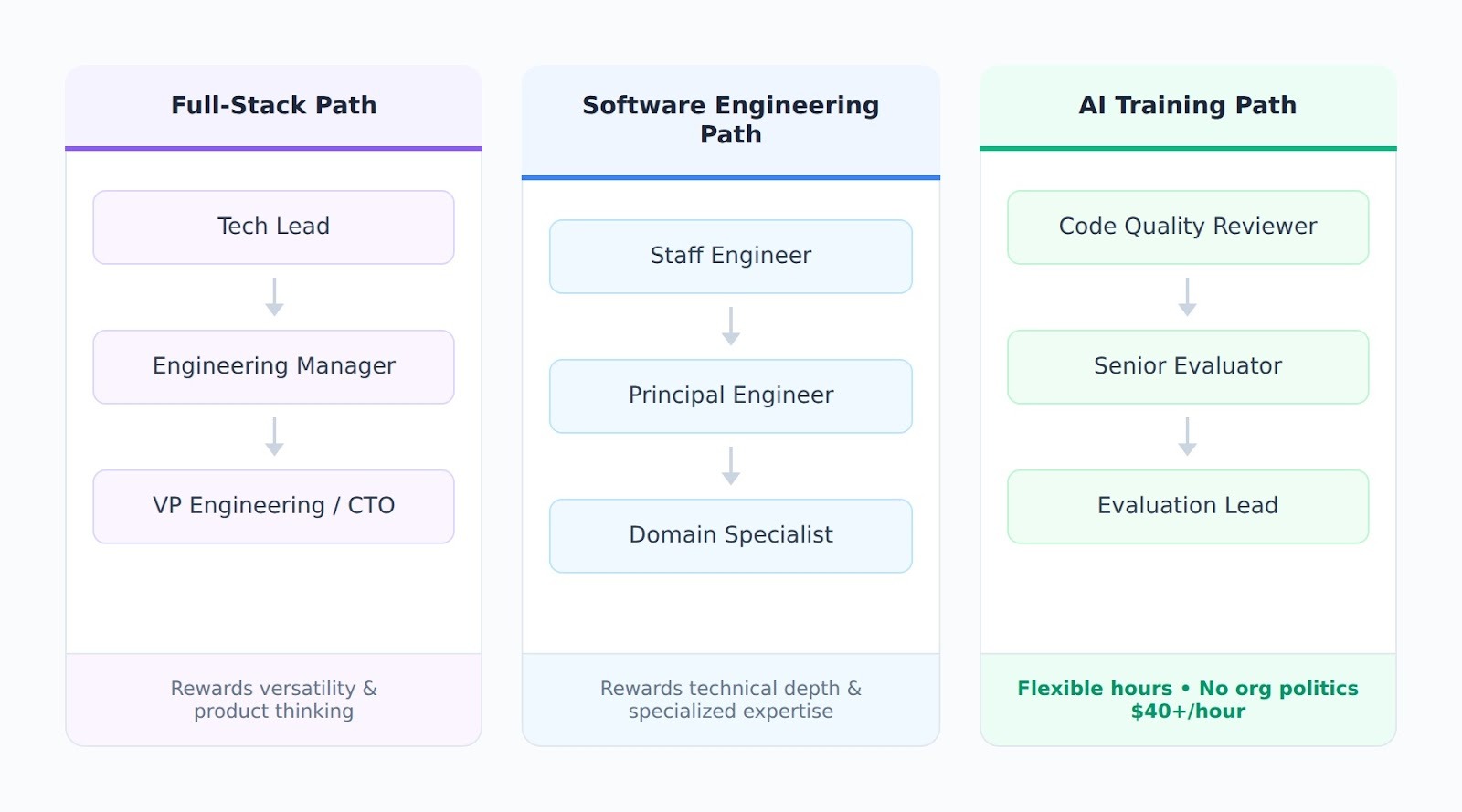
Full-stack developers advance in multiple directions because their versatile skill set opens opportunities across technical and product-focused roles:
- Tech lead or engineering manager: Guide development teams through technical decisions, project planning, and delivery timelines while remaining hands-on with code when needed.
- Product-oriented roles: Transition to positions like startup CTO or VP of Engineering, where technical knowledge combines with business strategy to drive product development from concept to market.
- Full-stack architect: Design comprehensive technical solutions that span the entire application stack and make high-level architectural decisions for growing engineering organizations.
Many full-stack developers maintain flexibility by continuing hands-on development while gradually assuming leadership responsibilities. This creates hybrid roles that blend technical depth with team coordination.
On the other hand, software engineers advance differently — typically deepening their specialization or branching into adjacent technical domains:
- Staff/principal engineer: Progress from implementing features to setting technical direction across entire organizations, making architectural decisions that affect multiple teams.
- Domain specialist: Master areas like distributed systems, machine learning infrastructure, or security engineering — becoming the expert others consult for complex technical problems.
- Engineering management: Guide technical teams while maintaining depth in specialized areas, though this often means narrowing focus rather than expanding it.
The career trajectories reflect the fundamental difference: full-stack roles reward versatility and product thinking, while engineering roles reward technical depth and specialized expertise.
A third trajectory exists outside traditional employment: using your technical judgment to train AI models directly. This path rewards the code evaluation skills both roles develop, without the organizational overhead that consumes most developer jobs. Want to give it a try? Get started with DataAnnotation today.
Full-stack developer vs. software engineer: why "just ship code" no longer defines software expertise
Five years ago, the mark of a productive full-stack developer or software engineer was implementation velocity. Write good features fast, ship constantly, measure output in pull requests per week. Speed was the skill that mattered.
Guess what?
AI is becoming a standard in developers’ and engineers’ lives. 85% of developers now regularly use AI tools for coding and development, and 62% rely on at least one AI coding assistant, agent, or code editor.
With AI, implementation speed is becoming commoditized. Technical discernment isn't. This shift creates demand for developers who can evaluate AI outputs — work that DataAnnotation pays $40+ per hour for because it requires exactly the judgment that implementation speed doesn't capture.
Why your taste in code matters more than the chosen field
Developers can implement features quickly once requirements are specified. Engineers earn their role by knowing what shouldn't be built, which abstractions serve future needs, and when to push back on product requirements that would create technical nightmares.
This shift was already happening before AI code generation. Now it's accelerating.
The developers who remain valuable aren't those who type fastest. They're the ones who can look at three different working implementations and articulate why one creates coupling problems, another violates principles of least surprise, and the third (while less elegant) better serves actual usage patterns.
This is taste: accumulated judgment about what makes code good beyond correctness. You develop it by shipping code and maintaining it, by debugging production issues caused by "clever" solutions, by working on enough systems to recognize patterns in what succeeds and what becomes technical debt.
AI models don't have taste yet. They can't explain why experienced developers grimace at specific code patterns that technically work. They can't anticipate which architectures will age well and which will feel brittle six months later.
Where judgment actually manifests in your work
Technical judgment shows up in moments between decisions:
In code review: You don't just verify the code works. You evaluate whether it's maintainable, whether it follows team patterns, whether it handles edge cases gracefully, and whether it's the right abstraction for the problem space.
In architecture discussions: Multiple approaches could work. The question is which creates the fewest future headaches, which scales most naturally, and which best serves unknown future requirements.
In debugging production issues: Finding the bug is often mechanical. Understanding why the bug happened and how to prevent similar problems requires pattern recognition across past failures.
In mentoring junior developers: You can't articulate all the rules that make code good. You point at examples and explain, "This works, but here's why we don't do it this way." That's judgment, not process.
These aren't separate activities you do occasionally. They're the core of what makes you valuable as an experienced developer or engineer. Implementation is table stakes. Judgment is what separates different skill levels.
AI training: an alternative to full-stack development and software engineering
At this point, almost every coder has encountered AI-generated code. You've probably used it to write boilerplate, debug issues, or explore unfamiliar libraries. The code works sometimes. Other times, it confidently produces solutions that fail in subtle ways.
That gap between "code that compiles" and "code you'd actually ship"? Companies will pay you to evaluate it.
Models improve by learning from developers and engineers who can articulate that gap — who can explain not just that generated code is wrong, but why it's wrong and what would make it better.
This isn't about job security or protecting your role from automation. It's about actively shaping what AI coding tools become capable of. The developers evaluating AI-generated code today directly influence what models can build tomorrow.
However, at DataAnnotation, we maintain selective standards because quality at the frontier scale requires genuine expertise, not just effort. If you're exploring AI training work because you heard it's easy money that anyone can do, we’re afraid, this isn't the right platform.
If you're looking to maximize hourly volume through minimal-effort clicking, there are commodity platforms better suited to that approach. If credentials matter more to you than demonstrated capability, our qualification process can discourage you.
Want to understand what legitimate AI training work looks like before applying? See how DataAnnotation compares to alternatives and why platforms that accept everyone produce data that teaches models to optimize for the wrong objectives.
Explore flexible coding projects at DataAnnotation
If you want to work where code quality determines frontier AI advancement and expertise compounds over time, DataAnnotation offers immediate access after a single qualification assessment.
If you want in, getting started is straightforward:
- Visit the DataAnnotation application page and click “Apply”
- Fill out the brief form with your background and availability
- Complete the Starter Assessment
- Check your inbox for the approval decision (which should arrive within a few days)
- Log in to your dashboard, choose your first project, and start earning
No signup fees. We stay selective to maintain quality standards. Just remember: you can only take the Starter Assessment once, so prepare thoroughly before starting.
Apply to DataAnnotation if you understand why quality beats volume in advancing frontier AI — and you have the expertise to contribute.
.jpeg)