
Every technical decision has a blast radius — the set of systems, teams, and people affected by the change. Your influence radius determines which decisions you can make without extensive negotiation.
Staff engineers have an influence radius that covers specific domains or product areas. As a staff engineer, you make architectural decisions, choose technologies, and solve complex problems — within boundaries established by others.
Principal engineers have an influence radius that extends across the entire organization. As a principal engineer, you set the boundaries that staff engineers operate within, establish patterns that shape how tons of engineers work, and make decisions that no single team has the authority to resolve.
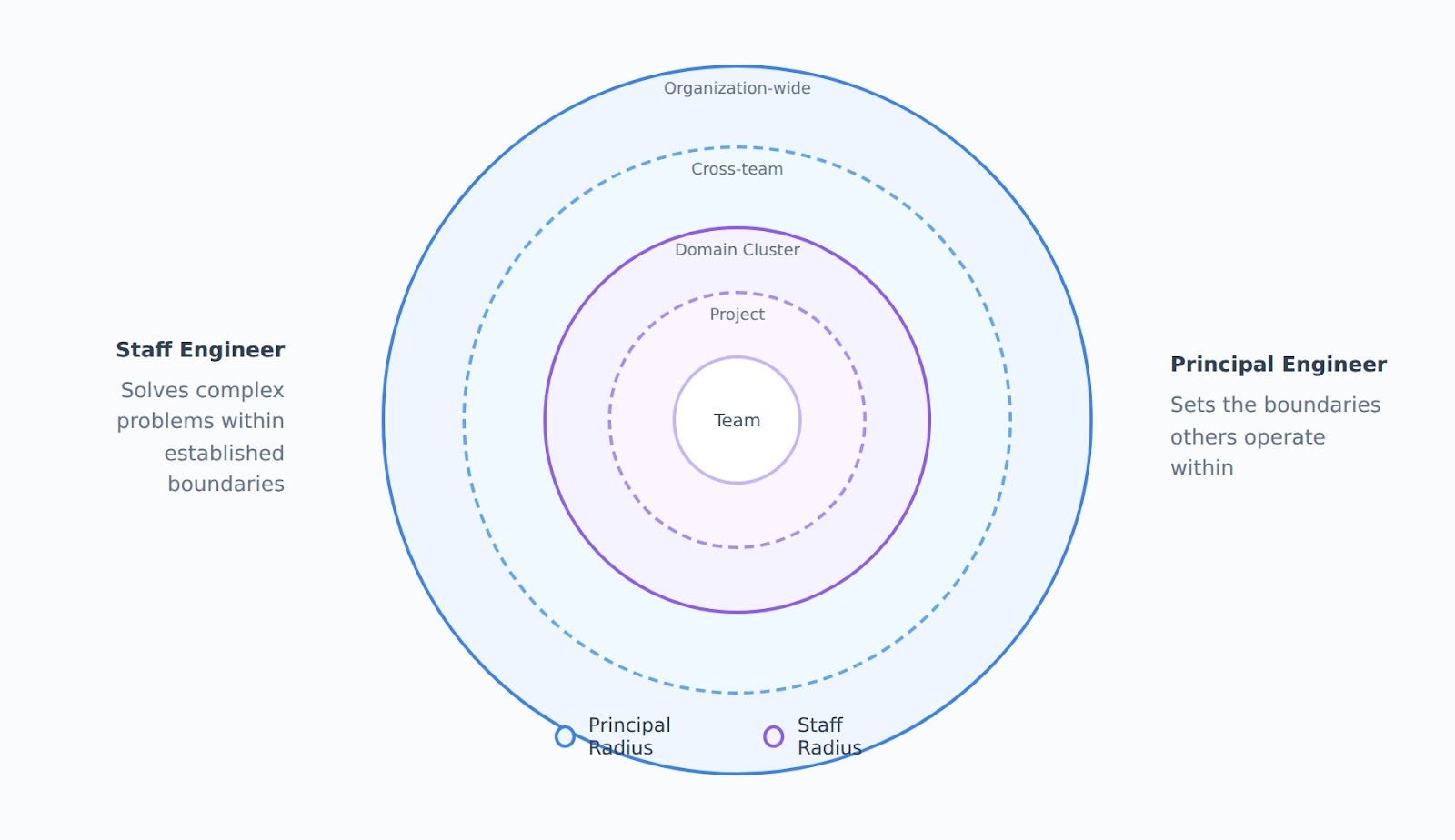
Both roles require technical depth. But the problems you can drive to completion depend entirely on whether your influence matches the problem's scope. In this guide, we break down the concrete differences between a staff engineer and a principal engineer.
5 main differences between a staff engineer and a principal engineer
Both the staff engineer and principal engineer titles signal senior individual contributor status, yet they require distinctly different approaches to technical leadership. Staff engineers excel as expert tacticians who solve deep domain problems, while principal engineers operate as strategic architects who connect multiple domains.
Here are the differences at a glance:
Autonomy and remote flexibility
Significant independence within project parameters. Align with director roadmaps and team sprint cadences.
Maximum self-direction across organizational boundaries. Spot unmet needs and propose company-wide initiatives without formal authority.
Understanding these key differences helps you determine which path aligns with your career goals and working style.
Both paths share something fundamental: the technical judgment you've built through years of debugging production systems, reviewing architecture decisions, and mentoring junior engineers. This judgment of knowing not just what works, but what will survive at scale is exactly what AI training work requires and what models still can't replicate.
Scope of impact
Staff engineers focus their technical decisions within a project cluster or specific domain. You solve complex problems close to the code, maintaining system reliability within established boundaries. Principal engineers operate at an organizational scale, with guidance that shapes architecture, tooling, and engineering culture across the entire company.
This broader mandate explains why principal engineers often report directly to senior leadership for technical counsel.
In remote environments, this distinction becomes more pronounced. Staff engineers participate in specific team standups and domain discussions. Principal engineers synchronize distributed groups around shared architectural visions, often across multiple time zones and product lines.
Technical ownership
Staff engineers have depth within specific technical areas. You become the authority on particular datastores, runtimes, or reliability platforms. Your expertise lies in understanding edge cases and keeping critical systems operational.
Principal engineers own breadth across the technical landscape. You define cross-cutting architecture, establish language standards, and chart long-term technical roadmaps that other engineers extend and implement.
For distributed teams, this ownership pattern significantly affects collaboration. Staff engineers maintain deep knowledge of specific components and can answer detailed questions within their domain. Principal engineers maintain system-wide coherence, ensuring that code written across different locations integrates smoothly.
Cross-team influence
Staff engineers exert influence across multiple teams and the entire organization. Your technical guidance reaches peers and closely related teams. Principal engineers serve as the organizational connective tissue, negotiating trade-offs across product lines, budgets, and sometimes external partnerships. You bridge engineering execution with executive decision-making.
Remote-first companies depend heavily on principal engineers to design architecture reviews and asynchronous communication patterns that keep globally distributed teams aligned. Staff engineers facilitate collaboration within their sphere. Principal engineers create the frameworks that enable cross-functional cooperation at scale.
Strategic decision-making
Staff engineers make high-stakes implementation decisions: library selection, performance optimization, and release unblocking.
Your technical choices directly impact project success. Principal engineers decide whether the company should build new systems, sunset existing databases, or migrate to different cloud providers. Your recommendations must satisfy long-term business objectives, not just technical elegance.
In remote work contexts, this distinction shapes daily responsibilities. Staff engineers execute strategy through detailed technical implementation. Principal engineers write strategy documents that must survive asynchronous handoffs and accommodate regional constraints, ensuring plans remain coherent across distributed teams.
Salary and value comparison
Market data reveals the premium placed on staff-level responsibility. Staff engineers average $249K in compensation, while global compensation for principal engineers averages $297K and can reach $350,000 or more annually in major tech hubs, with some high earners making over $400,000 or even $500,000.
Location amplifies these differences, with FAANG companies in high-cost metros offering principal engineers more than these figures. Equity grants and performance bonuses further tilt compensation toward staff roles because strategic decisions create compounding value across the organization.
Beyond expertise: why influence radius determines which technical problems you can actually solve
Consider a performance problem: API response times have degraded from 200ms to 2 seconds over the past month. Users are complaining. The CEO is asking questions.
A staff engineer with deep domain expertise can solve this problem if it's contained within their area. As a staff engineer, you profile the code, identify the bottleneck (maybe an N+1 query or an inefficient algorithm), optimize it, and deploy the fix. Problem solved in days, perhaps a week if testing is involved.
But what if the performance issue stems from architectural decisions made years ago?
What if five different teams have built services that all query the same database in inefficient ways?
What if the real solution requires migrating to a different datastore, which means coordinating changes across a dozen microservices owned by other teams?
Now you're outside your influence radius.
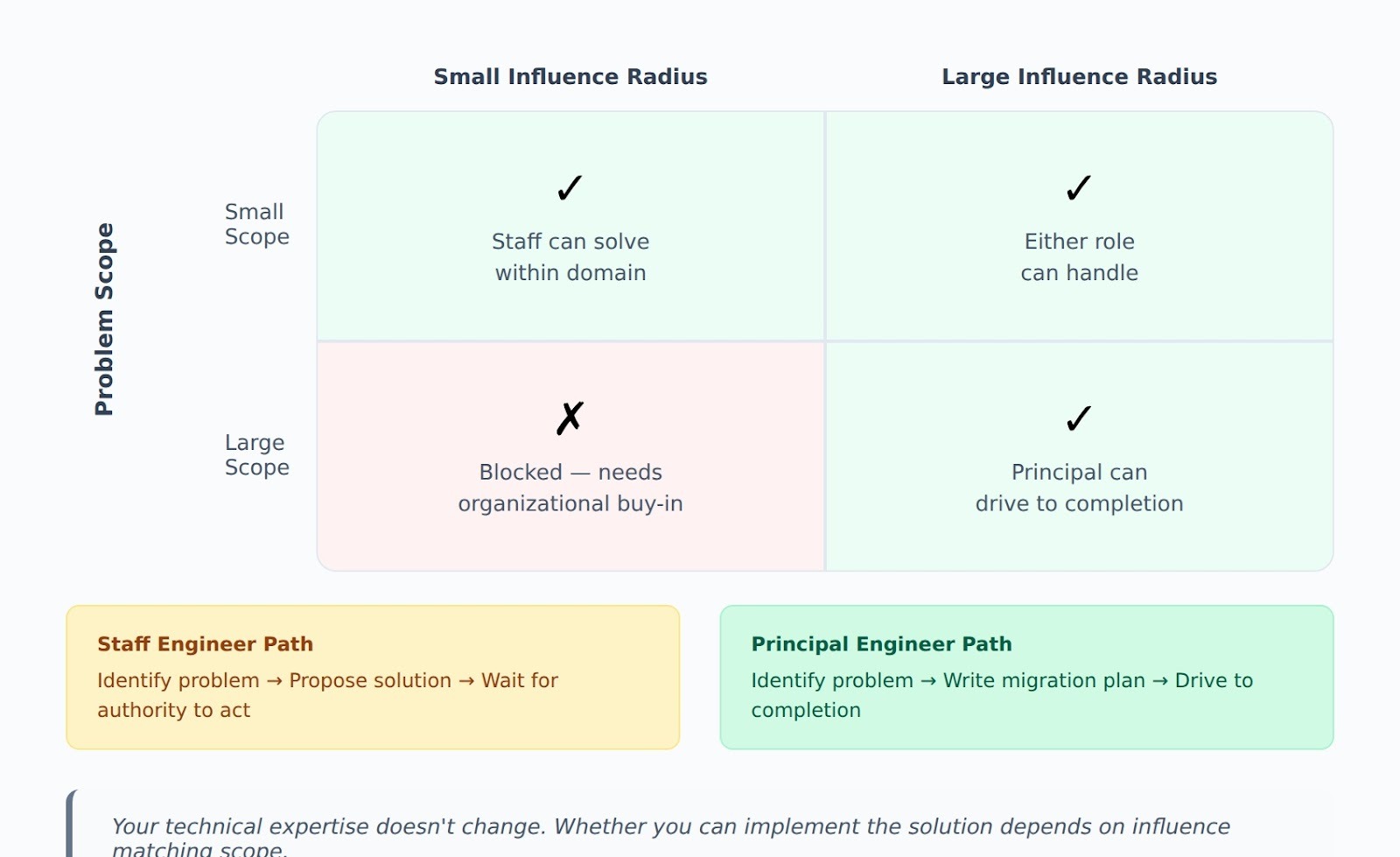
You can identify the problem. You can propose the solution. But you can't implement it without convincing multiple teams to prioritize work that doesn't directly benefit their roadmaps. You need buy-in from engineering managers who control sprint capacity.
You need approval from directors who control budgets, and you also need platform teams to build migration tooling before any service can start moving.
Your technical expertise hasn't changed. The problem's scope exceeds your influence radius.
This is where principal engineers operate naturally. You don't just identify that multiple teams are causing database contention. You write the migration plan that addresses everyone's constraints simultaneously.
Your influence radius extends far enough that you can actually drive the solution to completion, not just identify what needs to happen and hope someone with authority acts on it.
Frustrated by the gap between what you can identify and what you can implement? AI training work removes the organizational friction. Your evaluation of whether code creates technical debt, whether architectures will scale, whether migrations are feasible — that judgment has direct value at $40+/hour at DataAnnotation. Apply today.
How AI training work leverages both deep technical expertise and cross-system architectural judgment
Most engineers have used AI to generate code. Sometimes it works. Other times, it produces technically correct solutions that fail in production, or it makes architectural decisions that compound into technical debt.
Companies building frontier AI systems need expert engineers who can evaluate both types of failures — the deep domain issues that staff engineers catch instinctively and the cross-system problems that principal engineers recognize from experience.
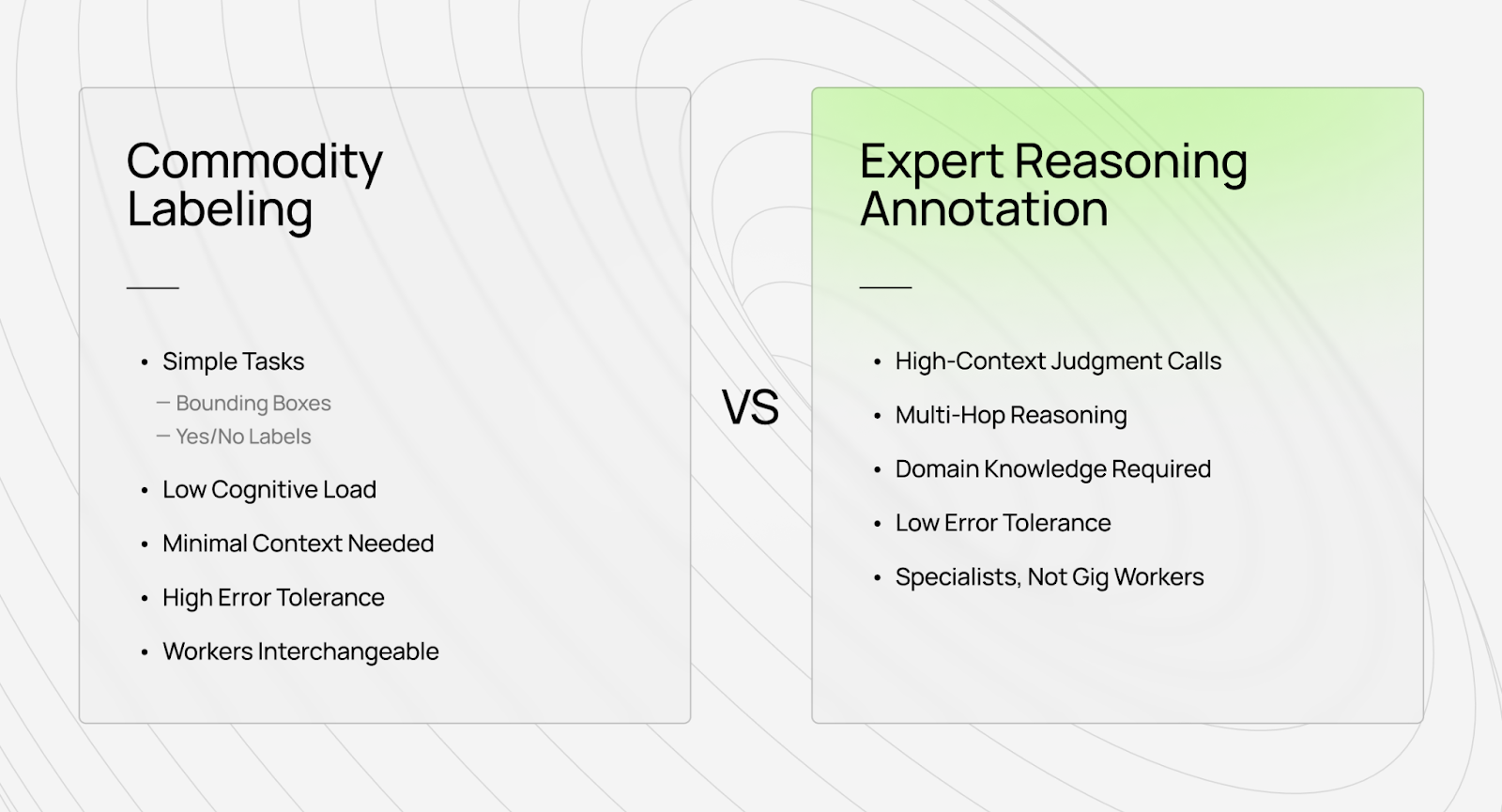
Models improve by learning from engineers operating at both scales. Staff-level domain expertise helps AI understand what makes database queries production-ready, when API designs will survive real users, and which algorithmic choices perform under load.
Principal-level architectural thinking helps AI learn when technology recommendations are organizationally feasible, how architectural changes affect downstream teams, and which migration strategies are actually executable.
This evaluation work doesn't replace your current role. It provides an alternative way to apply the judgment you've built — whether that's deep expertise in specific domains or a broad understanding of how technical decisions propagate across organizations.
The work shapes what AI systems learn about engineering at scale: not just how to write correct code, but how to make technical decisions that remain coherent as they move from implementation to architecture to organizational strategy.
Contribute to AGI development at DataAnnotation
At DataAnnotation, we‘re at the forefront of AI training and AGI development, where your judgment determines whether billion-dollar training runs advance capabilities or optimize for the wrong objectives.
This work shapes systems that millions of people will interact with.
If you want in, getting started is straightforward:
- Visit the DataAnnotation application page and click "Apply"
- Fill out the brief form with your background and availability
- Complete the Starter Assessment
- Check your inbox for the approval decision (which should arrive within a few days)
- Log in to your dashboard, choose your first project, and start earning
No signup fees. We stay selective to maintain quality standards. Just remember: you can only take the Starter Assessment once, so prepare thoroughly before starting.
Apply to DataAnnotation if you understand why quality beats volume in advancing frontier AI — and you have the expertise to contribute.
.jpeg)